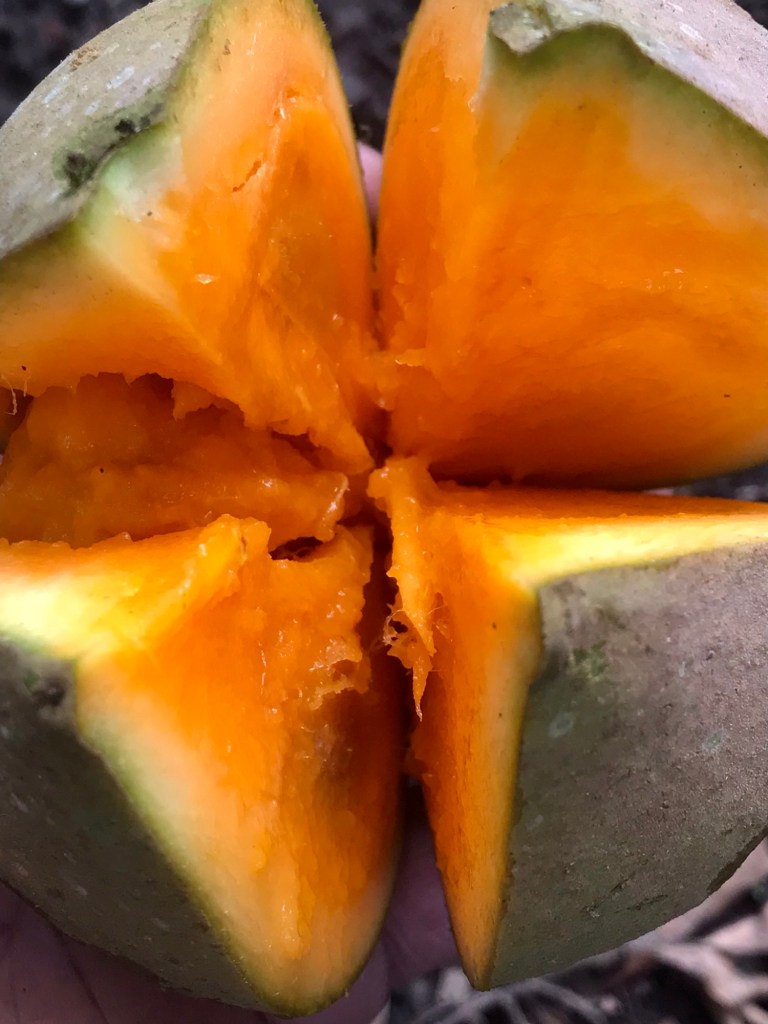
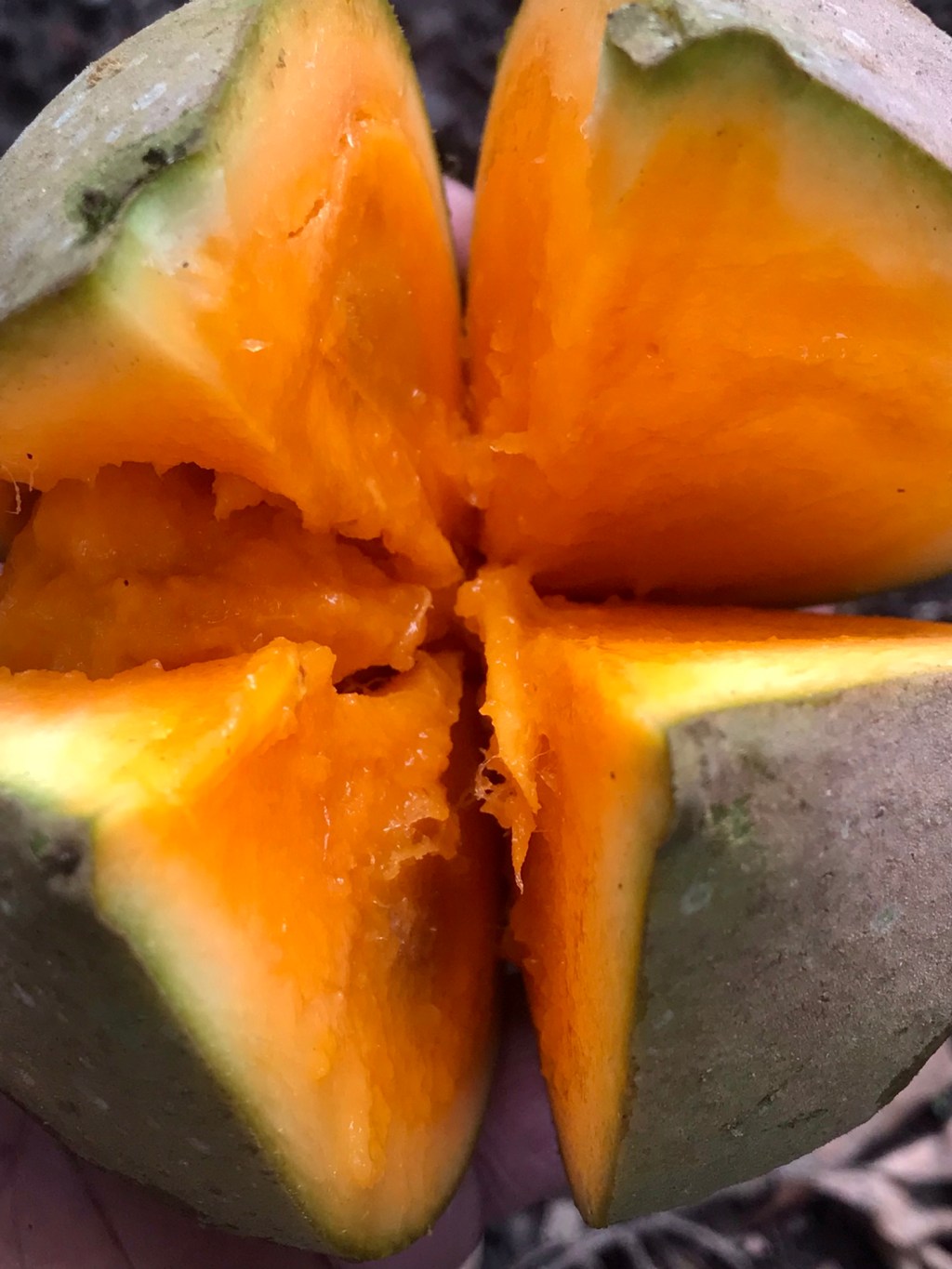
Once more I am stating with eyes and palate that color has flavor correlations. I do not trust either ability as being fully objective. Impossible. Therefore, I shall continue to find ways of challenging myself and these somewhat independent abilities, trying to exclude the influence of the subjective stance.
Nevertheless, for now, the fruit known in Macas, Ecuador as sapote or/and zapote, stronglly supports the correlation between color and flavor. Botanically, this one is the Matisia cordata Bonpland. Botanically, zapote is also a group of fruit trees, to which the likes of mamey, and persimmon belong to.
I heard much about the fruit in Mexico but never got to taste it. After having my second one some hours ago, the experience brings the thought back to mind that, in its natural essence, a flavor correlates to color.
In texture, the heart of the zapote, right next to the seed, is very juicy. The part closer to the peel is less sweet, more dense, and has fibers. The taste resembles that of the mango, though without the slightly tangy quality. Interestingly enough, the mango has tougher, finer fibers but they are closer to the seed, opposite to the zapote. In flavor it can also be compared to a very sweet pumpkin but without the nuttiness, and earthiness.
In another childhood reference, the Cuban mamey or mamey sapote, botanically Pouteria sapota (Jacquin) H. E. Moore & Stearn, is clearly in my memories of my father. In Cuba it is beloved as drink (shake). Eating the fruit, in taste and feel, a shake of it is a very logical alternative.

 Sila Blume
Leave a comment