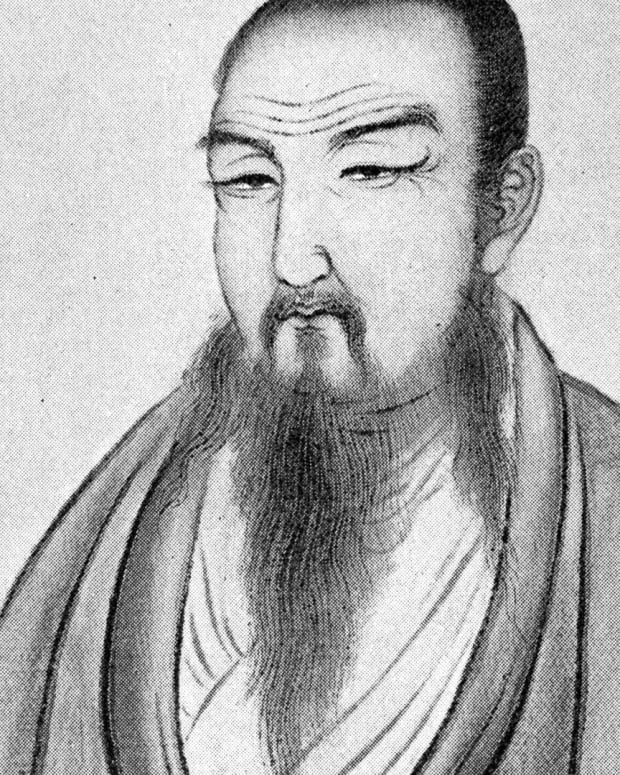
Confucius, born Kǒng Qiū 551, in Qufu, state of Lu [now in Shandong province, China] is China’s most famous teacher, philosopher, and political theorist, whose ideas have profoundly influenced the civilizations of China and other East Asian countries.
Confucius was born near the end of an era known in Chinese history as the Spring and Autumn Period (770–481 BCE). His home was in Lu, a regional state of eastern China in what is now central and southwestern Shandong province. Like other regional states at the time, Lu was bound to the imperial court of the Zhou dynasty (1045–221 BCE) through history, culture, family ties (which stretched back to the dynasty’s founding, when relatives of the Zhou rulers were enfeoffed as heads of the regional states), and moral obligations. According to some reports, Confucius’s early ancestors were the Kongs from the state of Song—an aristocratic family that produced several eminent counselors for the Song rulers. By the mid-7th century BCE, however, the family had lost political standing and most of its wealth, and some of the Kongs—Confucius’s great-grandfather being one—had relocated to the state of Lu.
The Kongs of Lu were common gentlemen (shi) with none of the hereditary entitlements their ancestors had once enjoyed in Song. The common gentlemen of the late Zhou dynasty could boast of their employability in the army or in any administrative position—because they were educated in the six arts of ritual (see below Teachings of Confucius), music, archery, charioteering, writing, and arithmetic—but in the social hierarchy of the time they were just a notch higher than the common folk. Confucius’s father, Shu-liang He, had been a warrior and served as a district steward in Lu, but he was already an old man when Confucius was born. A previous marriage had given him nine daughters and a clubfooted son, and so it was with Confucius that he was finally granted a healthy heir. But Shu-liang He died soon after Confucius’s birth, leaving his young widow to fend for herself.
Confucius was candid about his family background. He said that, because he was “poor and from a lowly station,” he could not enter government service as easily as young men from prominent families and so had to become “skilled in many menial things” (Analects [Lunyu], 9:6). He found employment first with the Jisun clan, a hereditary family whose principal members had for many decades served as chief counselors to the rulers of Lu. A series of modest positions with the Jisuns—as keeper of granaries and livestock and as district officer in the family’s feudal domain—led to more important appointments in the Lu government, first as minister of works and then as minister of crime.
Records of the time suggest that, as minister of crime, Confucius was effective in handling problems of law and order but was even more impressive in diplomatic assignments. He always made sure that the ruler and his mission were well prepared for the unexpected and for situations that might put them in harm’s way; he also knew how to advise them to bring a difficult negotiation to a successful conclusion. Yet he held his office for only a few years. His resignation was the result of a protracted struggle with the hereditary families—which, for generations, had been trying to wrestle power away from the legitimate rulers of Lu. Confucius found the actions of the families transgressive and their ritual indiscretions objectionable, and he was willing to fight by fair means or foul to have the power of the ruler restored. A major clash took place in 498 BCE. A plan to steer the families toward self-ruin backfired. The heads of the families suspected Confucius, and so he had no choice but to leave his position and his home.
The self-exile took Confucius on a long journey: first to Wei, the state just west of Lu, then southward to the state of Song, and finally to the states of Chen and Cai. The journey lasted 14 years, and Confucius spent much of that time looking for rulers who might be willing to accept his influence and be guided by his vision of virtuous government. Although his search was ultimately in vain, he never gave up, because he was eager for someone to “put me to use” (Analects, 17:5). He said to those who found his ambitions suspect, “How can I be like a bitter gourd that hangs from the end of a string and can not be eaten?” (Analects, 17:7).
Confucius was emboldened to think that he could set things right in the world, because he was born at a time when such aspirations were within the reach of men living in circumstances similar to his. By the mid-6th century BCE the Zhou dynasty was approaching its 500th year. The political framework that the dynastic founders had put in place—an enfeoffment system held together by family ties—was still standing, but the joints had been giving out since the beginning of the Spring and Autumn Period, and so the structure, if not shored up, was in danger of collapse. The regional rulers, who were relatives of the Zhou king, should have been his strongest supporters, but they preferred to pursue their own ambitions. In the century before Confucius’s birth, two or three of them simply acted on behalf of the king, and under their watch the empire managed to hold itself together and to keep enemies at bay. By Confucius’s time, however, such leaders had disappeared. No one among the regional rulers was interested in the security of the empire or the idea of the greater good. Petty feuds for petty gains consumed most of their time, while lethargy took up the rest. The same could be said of the members of the aristocratic class, who had once aided their ruler in government. Now they were gaining the upper hand, and some were so brazen as to openly compete with their ruler for wealth and women. Their apathy and ineptitude, however, allowed the common gentlemen—men like Confucius, who had once been in their service—to step in and take charge of the administrative functions of the government.
The common gentlemen, at this point, still could not displace the aristocrats as the society’s elite. Yet, if they worked hard enough and were smart, they could exert influence in most political contests. But the more discerning among them set their goals higher. They saw an opportunity to introduce a few new ideas about worth (xian) and nobleness (shang)—which, they felt, could challenge assumptions that had been used to justify the existing social hierarchy. They asked whether ability and strength of character should be the measures of a person’s worth and whether men of noble rank should be stripped of their titles and privileges for incompetence and moral indiscretion. Those who posed such questions were not merely seeking to compete in the political world. They wanted to change unspoken rules so as to favour the virtuous and the competent. This, in part, explains what Confucius was trying to teach. He believed that the moral resolve of a few could have a beneficial effect on the fate of the many. But integrity alone, in his view, would not be enough. Good men had to be tested in politics: they should equip themselves with knowledge and skills, serve their rulers well, and prove their worth through their moral influence.
The man Confucius looked back to for inspiration and guidance was Zhougong (the Duke of Zhou)—a brother of the founder of the Zhou dynasty and the regent of the king’s young son Chengwang. Despite the temporal distance between them, Confucius believed that he and the Duke of Zhou wanted the same thing for the dynasty: social harmony and political stability grounded in trust and mutual moral obligations, with minimal resort to legal rules. But the Duke of Zhou was royalty and Confucius was a professional bureaucrat, which meant that he had limited political authority. And even the authority he possessed was transient, depending on whether he had a government job. Without an official position, Confucius also would not be entitled (for example) to host a feast, to assist a ruler in a sacrifice, or to take part in any of the occasions that were the living components of the political order that the Duke of Zhou had envisioned and Confucius strongly endorsed. Thus, Confucius was distressed when he was unemployed—anxious about not being of use to the world and about not having material support. Men who knew him on his travels wondered whether his eagerness for a political position might have led him to overplay his hand and whether he had compromised his principles by allowing disreputable men and women to act as his intermediaries. His critics included the three or four of his disciples who accompanied him on his exile.
Confucius’s disciples were considerably younger than him. He did not actively recruit them when he was a counselor in Lu. He did not found any school or academy. Young men from a wide range of backgrounds—sons of aristocrats, children of common gentlemen, merchants, farmers, artisans, and even criminals and sons of criminals—chose to attach themselves to him in order to learn from him skills that might get them started on a path toward an official career. In the process, they acquired a lot more: in particular, a gentleman’s refinement and moral acuity, which in Confucius’s mind were essential to a political profession. Confucius was the “master” (zi) to these followers, who called themselves his “disciples” or “apprentices” (tu). Among his earliest disciples, three stood out: Zigong, Zilu, and Yan Hui.
Zigong had been a merchant before becoming Confucius’s disciple. He was articulate and shrewd and quick on his feet. Confucius observed in him a resolve to improve his lot and the promise of becoming a fine diplomat or a financial manager. He enjoyed Zigong’s company because Zigong was someone with whom he could share his thoughts about the world and the people they knew and about poetry and ritual practices (Analects, 11:3; 1:15; 11:19; 5:9).
Zilu, unlike Zigong, was rough and unhewn, a rustic man. Confucius knew that Zilu would do anything to protect him from harm: “wrestle a tiger with his bare hands” or “follow him on the open sea in a bamboo raft.” Yet, Confucius felt, simply being brave and loyal was “hardly the way to be good,” because, without the advantage of thought and a love for learning, people would not be able to know whether their judgment had been misguided or whether their actions might lead them and others onto a perilous road, if not a violent end (Analects, 5:7; 7:11). Still, Confucius took Zilu in, for he was someone “who did not feel ashamed standing next to a man wearing fox or badger fur while himself dressed in a tattered gown padded with silk floss” and who was so reliable that “by speaking from just one side of a dispute” in a court of law he could “bring a legal dispute to a conclusion” (Analects, 9:27; 12:12). Besides, Confucius did not deny instruction to anyone who wanted to learn and was unwilling to give up when trying to solve a difficult problem. In return, he expected nothing more than a bundle of dried meat as a gift (Analects, 7:7).
Confucius thought that the rites, or ritual (li)—encompassing and expressing proper human conduct in all spheres of life—could steady a man and anchor a government and that their practice should begin at home. “Give your parents no cause for worry other than your illness,” he said. “When your parents are alive, do not travel to distant places, and if you have to travel, you must tell them exactly where you are going” (Analects, 2:6, 4:19). But what if your parents are thinking of doing something wrong? “Be gentle when trying to dissuade them from wrongdoing,” Confucius advised. “If you see that they are inclined not to heed your advice, remain reverent (jing). Do not openly challenge them. Do not be resentful even when they wear you out and make you anxious” (Analects, 4:18). Every human relationship is a balancing act, and the one between child and parents is the most demanding yet the most deserving of attention and patience, because it is rooted in love and the child’s earliest memories of warmth and affection. Confucius did not want children to be acquiescent in situations that call for their judgment. At the same time, he discouraged confrontation even when the parents are culpable. He worried that parents might lose their sense of proportion and their child’s affection for them, and so he urged the child to “remain reverent” even if the parents are not inclined to heed the child’s advice. The rites, therefore, enable the child to avoid a clash without having to betray principles. But unless the child “acts according to the spirit of the rites, in being respectful, he will tire himself out; in being cautious, he will become timid” (Analects, 8:2).
Excerpts from Britannica


Leave a Reply