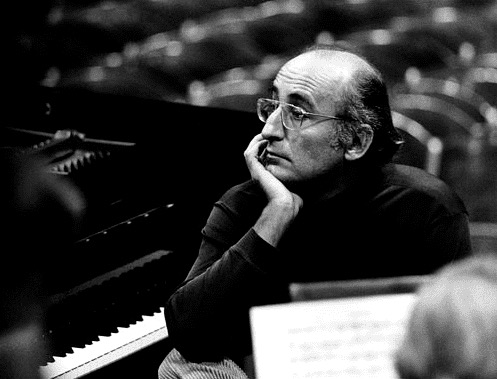
In a career that offered striking recordings in both the classical and jazz idioms, Friedrich Gulda was alternately described as “eccentric” and even a “terrorist pianist.” He refused to stay in his lane as an interpreter of the great European composers, entering the jazz field in a period of stunning transition and making a mark on both genres that resonated well beyond his lifetime.
In a Silent Way
Gulda was born in 1930 in Vienna, Austria, and was steeped in the city’s extensive musical traditions. He progressed mightily from his earliest piano lessons at the age of seven, studying piano and theory at the Vienna Music Academy before he was a teenager under the tutelage of Bruno Seidlhofer and Joseph Marx. Even then, though, his interests could not be contained to past masters: at the academy, he befriended a fellow student named Joe Zawinul, and the two would boldly learn jazz keyboards on their own at a time when Hitler’s German government condemned the genre for its attraction to Black and Jewish players. (Zawinul would, of course, become a pioneer in jazz fusion, collaborating with Miles Davis on In a Silent Way and Bitches Brew before co-founding Weather Report in the ’70s.)
Gulda’s breakthrough came in 1946 when he won the Geneva International Music Competition. The prize was not without controversy: supporters of competing Belgian pianist Lode Backx levied accusations of jury tampering. His victory made him an international sensation, hailed for his interpretations of concertos by Beethoven, Bach, Schubert, Chopin, and Debussy. In 1950, at 20 years old, he made his Carnegie Hall debut; a year later, his earliest recordings for the Decca label were released. With countrymen Jörg Demus and Paul Badura-Skoda (informally known as the “Viennese troika”), Gulda came to represent a post-war renaissance of classical interpretation from its fertile birthplace.
At Birdland
However, devotion to the genre was the least of Gulda’s musical interests. He found himself intoxicated by the possibilities of jazz, sitting in with Dizzy Gillespie at club dates, performing at the Newport Jazz Festival, and even recording a 1956 album with his own sextet, At Birdland, in 1956. Gulda’s disregard for conventions led him to simultaneously make strides in both classical and jazz. Through the ’60s and ’70s, he taught classical piano (Martha Argerich was a notable student) and recorded masterful renditions of Beethoven’s complete sonatas, a beloved version of Bach’s The Well-Tempered Clavier, and even two cadenzas to Mozart’s Piano Concertos No. 20 & 21 (recorded with the Vienna Philharmonic under the baton of Gulda’s former pupil Claudio Abbado). He also embarked on flights of fancy like 1969’s The Air from Other Planets (whose original “Prelude and Fugue” was covered by Emerson, Lake & Palmer); 1970’s As You Like It (featuring a celebrated take on The Doors’ Light My Fire); and even vocal jazz under the pseudonym Albert Golowin.
Age didn’t erode Gulda’s eccentricities. In 1969, after accepting a prestigious award from the Vienna Music Academy, he returned only days later. “There can be no guarantee that I will become a great jazz musician, but at least I shall know that I am doing the right thing,” he would say. “I don’t want to fall into the routine of the modern concert pianist’s life, nor do I want to ride the cheap triumphs of the Baroque bandwagon.” He immersed himself further into original compositions as his career continued: 1976’s Nachricht Vom Lande was a small-group free jazz experiment led by Gulda on clavichord and featured luminaries, including pianist Cecil Taylor and Gulda’s life partner, Ursula Anders. Other varied works included 1980’s genre-bending Concerto for Cello and Wind Orchestra, and a series of collaborations with Zawinul’s Return to Forever bandmate Chick Corea, including The Meeting (1983) and a 1984 recording of Mozart’s Double Concerto with the Royal Concertgebouw Orchestra. His later years were punctuated by behaviors that, to some, justified his “terrorist pianist” nickname, from refusing to announce the works he would play in concert ahead of time to prematurely announcing his own death in 1999 to make a later concert his “resurrection.” He succumbed to heart failure a year later, oddly fulfilling a stated wish to die on Mozart’s birthday.
By Mike Duquette
Source: all music


Leave a Reply