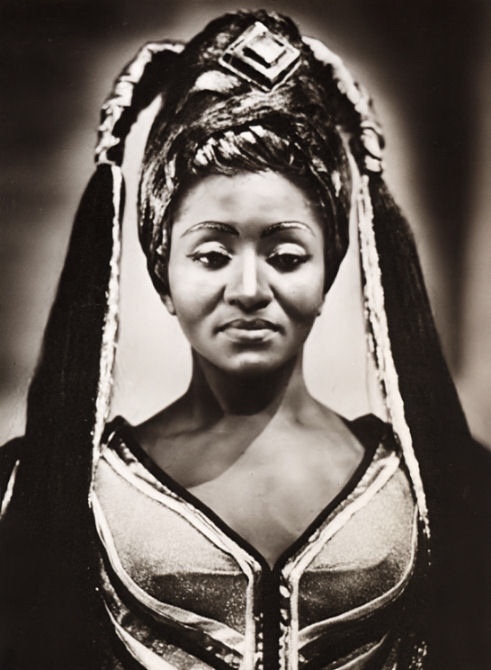
Grace Bumbry is a pioneering Mezzo & Soprano. Few mezzo-sopranos have successfully made the transition to becoming top sopranos. Grace Bumbry managed that. She was also a major figure in helping black singers find their rightful place on the opera stage in an era where segregation ran rampant.
Born on Jan. 4, 1937, the mezzo was born in St. Louis and won a local radio competition at age 17, singing “O Don Fatale,” an aria that would become a staple for her. She won a scholarship to a local conservatory, but faced segregation and was not admitted. Instead, she went to Boston University College of Fine Arts and later transferred to Northwestern University. She also studied at the Music Academy of the West under Lotte Lehmann and would be a joint winner of the 1958 Metropolitan Opera National Council Auditions; the other winner was Martina Arroyo.
She made her recital debut in Paris in 1958, followed by her opera debut in 1960 at the Paris Opéra. She went to Bayreuth in 1961 and made debuts at the Royal Opera House, La Scala, and the Met in 1963, 1964 and 1965, respectively. She famously received 42 curtain calls over 30 minutes during her Bayreuth debut in “Tannhäuser,” even though initial reactions to her casting were controversial.
She was also invited to the White House by Jacqueline Kennedy in 1961 and would return in 1981.
In 1970, she made her formal soprano debut as “Salome” at the Royal Opera House and debuted “Tosca” at the Met a year later; her first true soprano role had been that of Lady Macbeth in Verdi’s opera in 1964. Her first “Norma” came in 1977 in Martina Franca. In her later career, she alternated soprano and mezzo roles, her final performances coming in the late 1990’s.
She left behind many recordings and was inducted in the St. Louis Walk of Fame. She was also given the UNESCO Awards, named Commandeur des Arts et Lettres by the French government and given Kennedy Center Honors in 2009.
Signature Roles:
As a mezzo, Bumbry was a renowned interpreter of the major Verdi roles such as Eboli and Amneris. She was also a renowned “Carmen” interpreter, making a number of major company debuts as the famed Bizet heroine.
As a soprano, her “Tosca” was her most famed role and she noted it among one of her favorite roles to perform. There are a number of recordings of her “Tosca.”
By David Salazar
Source: Opera Wire

 Sila Blume
Leave a reply to Dr Banerjee Cancel reply