January 1st of:
45 BC The Julian calendar takes effect for the first time by edict of Roman dictator Julius Caesar
1 Origin of the Christian Era, now widely accepted as “Common Era”
1430 Jews of Sicily are no longer required to attend conversion services
1502 A Portuguese expedition under Pedro Álvares Cabral is the first European group to discover the Bay of Guanabara, naming it Rio de Janeiro after mistaking it for a river entrance
1583 First day of the Gregorian calendar in Holland and Flanders, after Gregory conquers Julius Caesar
1600 Scotland begins its numbered year on January 1 instead of March 25
1660 The Academia de Bellas Artes is founded in Seville with painter Bartolomé Esteban Murillo as its first president
1700 Protestant Western Europe, except England, begins to use the Gregorian calendar
1724 Glassblower Daniel Gabriel Fahrenheit proposes a system for making thermometers, and the Fahrenheit temperature scale in a paper to the Royal Society of London, and is elected a fellow on this basis
1758 The International Commission on Zoological Nomenclature establishes the starting point for standardized species names across the animal kingdom, based on the binomial nomenclature in the 10th edition of Systema Naturae by Carl Linnaeus
1772 The London Credit Exchange Company issues the first traveler’s cheques which can be used in 90 European cities
1788 Quakers in Pennsylvania emancipate their enslaved people
1797 Albany replaces New York City as the capital of New York
1798 Russia appoints first Jewish censor to censor Hebrew books
1801 The Irish Parliament votes to join the Kingdom of Great Britain, forming the United Kingdom of Great Britain and Ireland
1804 Haiti gains independence from France (National Day), becoming the only state ever founded by formerly enslaved people and without slavery
1808 The US Congress prohibits the importation of slaves
1818 Mary Shelley’s “Frankenstein; or, The Modern Prometheus” is published anonymously by the small London publishing house of Lackington, Hughes, Harding, Mavor, & Jones
1842 New York Illustrated News, the first illustrated weekly magazine in the US, publishes its first issue in New York
1845 Cobble Hill Tunnel in Brooklyn is completed, becoming the world’s first subway tunnel
1852 The first US public bath opens in New York City
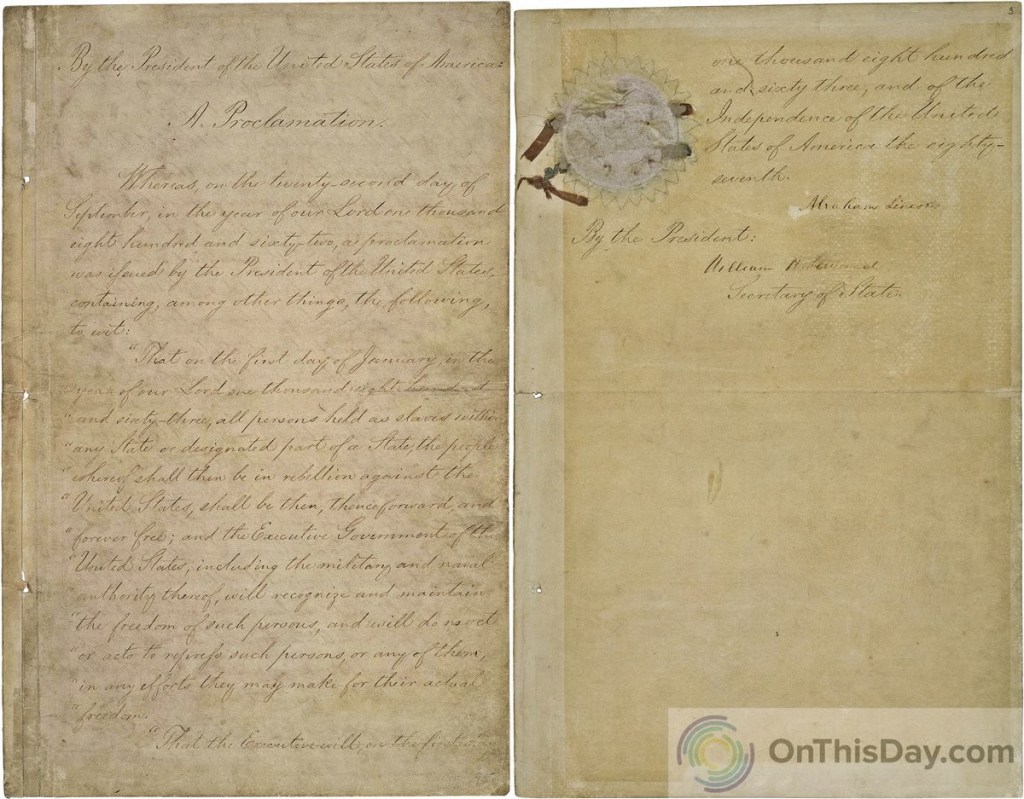
1863 Abraham Lincoln issues the Emancipation Proclamation to free enslaved people in Confederate states
1873 Japan adopts the Gregorian calendar
1875 Britain’s Midland Railway abolishes second-class travel, ending the practice of carrying third-class passengers in open-air wagons
1879 Johannes Brahms’ Violin Concerto in D major, Op. 77, premieres in Leipzig
1881 Dr. John Watson is first introduced to the character Sherlock Holmes in a story written by Arthur Conan Doyle
1892 Ellis Island opens as a US immigration inspection station, and becomes the gateway to the United States for more than 12 million people
1896 German physicist Wilhelm Röntgen announces his discovery of X-rays
1898 Brooklyn merges with New York City to form the present-day City of New York
1899 The government of Cuba is handed over to the US from Spanish rule; American occupation continues until 1902
1912 Sun Yat-sen forms the Republic of China
1913 US Post office begins parcel post deliveries
1916 First blood transfusion using stored and cooled blood is performed
1928 1st US fully air-conditioned office building opens in San Antonio, Texas, designed by George Willis with Willis Carrier’s humidity control system.
Source: On This Day


Leave a Reply