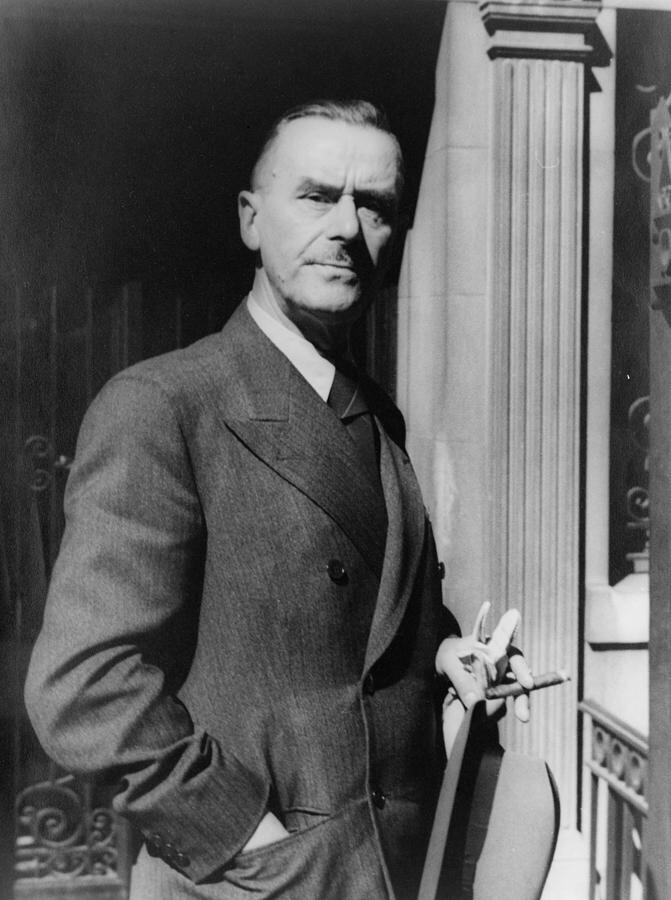
Thomas Mann, born June 6, 1875, in Lübeck, Germany, is the novelist and essayist whose early novels—Buddenbrooks (1900), Der Tod in Venedig (1912; Death in Venice), and Der Zauberberg (1924; The Magic Mountain)—earned him the Nobel Prize for Literature in 1929.
Early literary endeavours
Mann’s father died in 1891, and Mann moved to Munich, a centre of art and literature, where he lived until 1933. After perfunctory work in an insurance office and on the editorial staff of Simplicissimus, a satirical weekly, he devoted himself to writing, as his elder brother Heinrich had already done. His early tales, collected as Der kleine Herr Friedemann (1898), reflect the aestheticism of the 1890s but are given depth by the influence of the philosophers Schopenhauer and Nietzsche and the composer Wagner, to all of whom Mann was always to acknowledge a deep, if ambiguous, debt. Most of Mann’s first stories centre in the problem of the creative artist, who in his devotion to form contests the meaninglessness of existence, an antithesis that Mann enlarged into that between spirit (Geist) and life (Leben). But while he showed sympathy for the artistic misfits he described, Mann was also aware that the world of imagination is a world of make-believe, and the closeness of the artist to the charlatan was already becoming a theme. At the same time, a certain nostalgia for ordinary, unproblematical life appeared in his work.
This ambivalence found full expression in his first novel, Buddenbrooks, which Mann had at first intended to be a novella in which the experience of the transcendental realities of Wagner’s music would extinguish the will to live in the son of a bourgeois family. On this beginning, the novel builds the story of the family and its business house over four generations, showing how an artistic streak not only unfits the family’s later members for the practicalities of business life but undermines their vitality as well. But, almost against his will, in Buddenbrooks Mann wrote a tender elegy for the old bourgeois virtues.
In 1905 Mann married Katja Pringsheim. There were six children of the marriage, which was a happy one. It was this happiness, perhaps, that led Mann, in Royal Highness, to provide a fairy-tale reconciliation of “form” and “life,” of degenerate feudal authority and the vigour of modern American capitalism. In 1912, however, he returned to the tragic dilemma of the artist with Death in Venice, a sombre masterpiece. In this story, the main character, a distinguished writer whose nervous and “decadent” sensibility is controlled by the discipline of style and composition, seeks relaxation from overstrain in Venice, where, as disease creeps over the city, he succumbs to an infatuation and the wish for death. Symbols of eros and death weave a subtle pattern in the sensuous opulence of this tale, which closes an epoch in Mann’s work.
World War I and political crisis
The outbreak of World War I evoked Mann’s ardent patriotism and awoke, too, an awareness of the artist’s social commitment. His brother Heinrich was one of the few German writers to question German war aims, and his criticism of German authoritarianism stung Thomas to a bitter attack on cosmopolitan litterateurs. In 1918 he published a large political treatise, Reflections of an Unpolitical Man, in which all his ingenuity of mind was summoned to justify the authoritarian state as against democracy, creative irrationalism as against “flat” rationalism, and inward culture as against moralistic civilization. This work belongs to the tradition of “revolutionary conservatism” that leads from the 19th-century German nationalistic and antidemocratic thinkers Paul Anton de Lagarde and Houston Stewart Chamberlain, the apostle of the superiority of the “Germanic” race, toward National Socialism; and Mann later was to repudiate these ideas.
With the establishment of the German (Weimar) Republic in 1919, Mann slowly revised his outlook; the essays “Goethe und Tolstoi” and “Von deutscher Republik” (“The German Republic”) show his somewhat hesitant espousal of democratic principles. His new position was clarified in the novel The Magic Mountain. Its theme grows out of an earlier motif: a young engineer, Hans Castorp, visiting a cousin in a sanatorium in Davos, abandons practical life to submit to the rich seductions of disease, inwardness, and death. But the sanatorium comes to be the spiritual reflection of the possibilities and dangers of the actual world. In the end, somewhat skeptically but humanely, Castorp decides for life and service to his people: a decision Mann calls “a leave-taking from many a perilous sympathy, enchantment, and temptation, to which the European soul had been inclined.” In this great work Mann formulates with remarkable insight the fateful choices facing Europe.
World War II and exile
From this time onward Mann’s imaginative effort was directed to the novel, scarcely interrupted by the charming personal novella Early Sorrow or by Mario and the Magician, a novella that, in the person of a seedy illusionist, symbolizes the character of Fascism. His literary and cultural essays began to play an ever-growing part in elucidating and communicating his awareness of the fragility of humaneness, tolerance, and reason in the face of political crisis. His essays on Freud (1929) and Wagner (1933) are concerned with this, as are those on Goethe (1932), who more and more became for Mann an exemplary figure in his wisdom and balance. The various essays on Nietzsche document with particular poignancy Mann’s struggle against attitudes once dear to him. In 1930 he gave a courageous address in Berlin, “Ein Appell an die Vernunft” (“An Appeal to Reason”), appealing for the formation of a common front of the cultured bourgeoisie and the Socialist working class against the inhuman fanaticism of the National Socialists. In essays and on lecture tours in Germany, to Paris, Vienna, Warsaw, Amsterdam, and elsewhere during the 1930s, Mann, while steadfastly attacking Nazi policy, often expressed sympathy with socialist and communist principles in the very general sense that they were the guarantee of humanism and freedom.
When Hitler became chancellor early in 1933, Mann and his wife, on holiday in Switzerland, were warned by their son and daughter in Munich not to return. For some years his home was in Switzerland, near Zürich, but he traveled widely, visiting the United States on lecture tours and finally, in 1938, settling there, first at Princeton, and from 1941 to 1952 in southern California. In 1936 he was deprived of his German citizenship; in the same year the University of Bonn took away the honorary doctorate it had bestowed in 1919 (it was restored in 1949). From 1936 to 1944 Mann was a citizen of Czechoslovakia. In 1944 he became a U.S. citizen.
After the war, Mann visited both East Germany and West Germany several times and received many public honours, but he refused to return to Germany to live. In 1952 he settled again near Zürich. His last major essays—on Goethe (1949), Chekhov (1954), and Schiller (1955)—are impressive evocations of the moral and social responsibilities of writers.
Later novels of Thomas Mann
The novels on which Mann was working throughout this period reflect variously the cultural crisis of his times. In 1933 he published The Tales of Jacob (U.S. title, Joseph and His Brothers), the first part of his four-part novel on the biblical Joseph, continued the following year in The Young Joseph and two years later with Joseph in Egypt, and completed with Joseph the Provider in 1943. In the complete work, published as Joseph and His Brothers, Mann reinterpreted the biblical story as the emergence of mobile, responsible individuality out of the tribal collective, of history out of myth, and of a human God out of the unknowable. In the first volume a timeless myth seems to be reenacted in the lives of the Hebrews. Joseph, however, though sustained by the belief that his life too is the reenactment of a myth, is thrown out of the “timeless collective” into Egypt, the world of change and history, and there learns the management of events, ideas, and himself. Though based on wide and scholarly study of history, the work is not a historical novel, and the “history” is full of irony and humour, of conscious modernization. Mann’s concern is to provide a myth for his own times, capable of sustaining and directing his generation and of restoring a belief in the power of humane reason.
Mann took time off from this work to write, in the same spirit, his Lotte in Weimar (U.S. title, The Beloved Returns). Lotte Kestner, the heroine of Goethe’s The Sorrows of Young Werther, his semi-autobiographical story of unrequited love and romantic despair, visits Weimar in old age to see once again her old lover, now famous, and win some acknowledgment from him. But Goethe remains distant and refuses to reenter the past; she learns from him that true reverence for man means also acceptance of and reverence for change, intelligent activity directed to the “demand of the day.” In this, as in the Joseph novels, in settings so distant from his own time, Mann was seeking to define the essential principles of humane civilization; their spacious and often humorous serenity of tone implicitly challenges the inhuman irrationalism of the Nazis.
In Doktor Faustus, begun in 1943 at the darkest period of the war, Mann wrote the most directly political of his novels. It is the life story of a German composer, Adrian Leverkühn, born in 1885, who dies in 1940 after 10 years of mental alienation. A solitary, estranged figure, he “speaks” the experience of his times in his music, and the story of Leverkühn’s compositions is that of German culture in the two decades before 1930—more specifically of the collapse of traditional humanism and the victory of the mixture of sophisticated nihilism and barbaric primitivism that undermine it. With imaginative insight Mann interpreted the new musical forms and themes of Leverkühn’s compositions up to the final work, a setting of the lament of Doctor Faustus in the 16th-century version of the Faust legend, who once, in hope, had made a pact with the Devil, but in the end is reduced to hopelessness. The one gleam of hope in this sombre work, however, in which the personal tragedy of Leverkühn is subtly related to Germany’s destruction in the war through the comments of the fictitious narrator, Zeitblom, lies in its very grief.
The composition of the novel was fully documented by Mann in 1949 in The Genesis of a Novel. Doktor Faustus exhausted him as no other work of his had done, and The Holy Sinner and The Black Swan, published in 1951 and 1953, respectively, show a relaxation of intensity in spite of their accomplished, even virtuoso style. Mann rounded off his imaginative work in 1954 with The Confessions of Felix Krull, Confidence Man, the light, often uproariously funny story of a confidence man who wins the favour and love of others by enacting the roles they desire of him.
Mann’s style is finely wrought and full of resources, enriched by humour, irony, and parody; his composition is subtle and many-layered, brilliantly realistic on one level and yet reaching to deeper levels of symbolism. His works lack simplicity, and his tendency to set his characters at a distance by his own ironical view of them has sometimes laid him open to the charge of lack of heart. He was, however, aware that simplicity and sentiment lend themselves to manipulation by ideological and political powers, and the sometimes elaborate sophistication of his works cannot hide from the discerning reader his underlying impassioned and tender solicitude for mankind.
Legacy
Mann was the greatest German novelist of the 20th century, and by the end of his life his works had acquired the status of classics both within and without Germany. His subtly structured novels and shorter stories constitute a persistent and imaginative enquiry into the nature of Western bourgeois culture, in which a haunting awareness of its precariousness and threatened disintegration is balanced by an appreciation of and tender concern for its spiritual achievements. Round this central theme cluster a group of related problems that recur in different forms—the relation of thought to reality and of the artist to society, the complexity of reality and of time, the seductions of spirituality, eros, and death. Mann’s imaginative and practical involvement in the social and political catastrophes of his time provided him with fresh insights that make his work rich and varied. His finely wrought essays, notably those on Tolstoy, Goethe, Freud, and Nietzsche, record the intellectual struggles through which he reached the ethical commitment that shapes the major imaginative works.
Roy Pascal / Source: Britannica
Death in Venice is a story about the artist and the nature of art. At the opening of the novella, Gustav von Aschenbach, while possessing a latent sensuality, exists as a man who has always held his passions in check, never allowing them expression either in his life or in his art. Like the turn-of-the-century bourgeois European culture he represents, Aschenbach is, in Freudian terms, “repressed”; a state of such imbalance that, it was believed, could not long remain stable, nor could it produce truly inspired art. However, having kept his passions under such tight control for so long, once Aschenbach begins to let down his guard against them, they rise up in redoubled force and take over his life. Once Aschenbach admits sensual beauty into his life, represented by the boy Tadzio, all of his moral standards break down, and he becomes a slave to beauty, a slave to desire; he becomes debased. Thus, Aschenbach undergoes a total displacement from one extreme of art to the other, from the cerebral to the physical, from pure form to pure emotion. Thomas Mann’s novella warns of the dangers–indeed, the deathly dangers–posed by either extreme.
The Legend of Sleepy Hollow
Death in Venice is written according to a method Thomas Mann called “myth plus psychology.” Both elements play equally important roles in tracing Aschenbach’s decline. Tadzio is described in mythical terms and compared to Greek sculpture, to the god of love, to Hyacinth and Narcissus, to Plato’s character Phaedrus. Aschenbach’s trip across the lagoon into Venice is portrayed in terms that suggest the legendary journey across the River Styx into the Underworld. Strange red-haired figures consistently reappear to Aschenbach, suggesting demons or devils. All of these mythological references serve to universalize the characters and their experiences in the story. Psychological elements also figure prominently in the novella: At the beginning of the plot, Aschenbach has firmly repressed his libidinal drives. Yet, as Freud would have predicted, repression only forces his drives to emerge by some other means, through dreams: Aschenbach has daydreams with the intensity of visions. His daydream of a tropical swamp and his dream of the orgiastic worship of the “stranger-god” epitomize the Freudian longing for the ultimate erotic abandon in death.
Thomas Mann was an economical and oblique writer. He does not waste a word: Every detail he includes is significant, and every detail serves his strategy of suggesting, hinting, rather than directly telling. Seemingly marginal particulars, such as a stormy sky, the stonemasons’ yards selling blank gravestones, the black color of the gondola, or the long, exposed teeth of a grimacing figure, reminiscent of a skull, are all instrumental in establishing an atmosphere of foreboding and death. The reader need not wait for the end of the story to make the link between sensual art and death; Mann forges the link gradually through a variety of motifs working in concert.
Source: spark notes
Death in Venice
SYNOPSIS
In Death in Venice, the German writer, Aschenbach, decides to travel to Venice. Upon his arrival, he starts to lust after a young Polish boy, Tadzio. He becomes obsessed with the boy. When he hears of a cholera outbreak in Venice, he debates whether or not he should warn the boy’s mother. One day, he watches Tadzio playing on the beach with his friends. However, the game gets rough and one boy pushes Tadzio’s face in the ground. Aschenback tries to get up and assist but falls back in his chair, dead.
Death in Venice, Opus 88
Opera in two acts
Music: Benjamin Britten
Libretto: Myfanwy Piper
ACT I
SCENE 1: Munich
The famous writer Gustav von Aschenbach finds his inspiration failing in his 50s. Walking past a cemetery he meets a mysterious traveller who puts into his mind the idea of travel to exotic foreign parts. He yields to the impulse to go south in the hope of spiritual refreshment.
SCENE 2: On the boat to Venice
A rouged elderly fop pesters Aschenbach with his conversation and insinuations that Aschenbach is in search of a “little darling,” and Aschenbach finds that the approach to Venice does not give him the joy he was expecting.
SCENE 3: The journey to the Lido
In a gondola on the way to his hotel Aschenbach wakes from a reverie about “ambiguous Venice” to find he is being taken the wrong way. Despite his protests, the old gondolier refuses to change course, saying that “the signore will pay.”
At the quay the gondolier disappears without waiting to be paid, leaving Aschenbach to compare his strange voyage with the journey across the Styx with Charon the ferryman.
SCENE 4: The first evening at the hotel
The hotel manager welcomes Aschenbach effusively and shows him his room, with a view of the beach. Aschenbach reflects ironically on the contrast between his distinguished career and his present experiences, where everything is strange and “out of focus.”
Watching the cosmopolitan guests preparing for dinner, he is particularly struck by a young Polish boy, whose mysterious beauty is in marked contrast to his two plain sisters. Aschenbach reflects on the artist’s “treacherous proneness to side with beauty.”
SCENE 5: On the beach
The weather is oppressive. Aschenbach is unable to work and fears he may have to leave. He watches children at play and buys some strawberries from an itinerant vendor and begins to find peace in the scene, seeing in the sea a form of the perfection he has always striven for.
The beautiful Polish boy joins the children, and assumes the position of leader. Aschenbach hears his name – Tadzio – and feels a father’s pleasure in the boy’s beauty which it seems he might almost have created himself. He reflects that his life has become too detached and solitary.
SCENE 6: The foiled departure
Aschenbach crosses to the city in a gondola and strolls through the streets, where he is pestered by would-be guides, beggars and street vendors. Oppressed by the weather and the crowd he feels the need for fresh mountain air, and rushes back to the hotel to announce his departure, to the fulsome regret of the manager.
Although finding the air fresher and regretting the shortness of his acquaintance with Tadzio, he sets off by gondola, but finds that his luggage has been put on the wrong train. He decides to return, glad that his hand has been forced and feeling invigorated, for once, by the disruption to his normally orderly way of life.
Seeing Tadzio again, he realises that the boy is the reason for his reluctance to leave.
SCENE 7: The games of Apollo
Aschenbach sits in a chair on the beach watching Tadzio and the other children playing. They work their way through the five sports of the Greek pentathlon, with a commentary by the chorus and the voice of Apollo, so that the games are transformed into a ritual.
Tadzio wins everything and the voice of Apollo proclaims that “beauty is the mirror of spirit.”
Aschenbach feels his inspiration renewed by Tadzio – he will be set free by beauty. He wishes to congratulate Tadzio, but even though the boy smiles as he passes, Aschenbach is strangely tongue-tied, only able to stammer “I love you” after Tadzio has gone.
ACT II
Aschenbach broods on the fact that he could find only those hackneyed words to express his emotion.
SCENE 8: The barber’s shop (1)
The hotel barber mentions “the sickness,” but changes the subject when Aschenbach asks him to explain.
SCENE 9: The pursuit
Crossing to the city Aschenbach finds notices giving warnings about infection. No one will answer his questions, but he buys a German newspaper and learns that cholera is suspected in the city.
Seeing the Polish family, he resolves that they must learn nothing that may make them leave. He follows them into St Mark’s and is sure that Tadzio is aware of him. He follows their gondola back to the hotel – first reproaching himself for his weakness, then bowing to the power of Eros.
SCENE 10: The strolling players
Three singers perform for the hotel guests. When the leader takes his hat around Aschenbach questions him about the plague, but is answered evasively.
The players sing a mocking song and Aschenbach is pleased because Tadzio does not join in the general laughter, but remains aloof like him.
SCENE 11: The travel bureau
An English clerk is trying to deal with a crowd of people wanting to make arrangements to leave Venice. He tells Aschenbach the truth about the cholera, describing its progress westwards from the delta of the River Ganges.
Warning of the chaos to come, he advises Aschenbach to leave while he can.
SCENE 12: The lady of the pearls
Aschenbach tries to bring himself to warn Tadzio’s mother, but finds himself tongue-tied. He realises that he is beginning to welcome the general disintegration and toying with the idea that only he and Tadzio might be left alive.
SCENE 13: The dream
Aschenbach dreams a debate between Dionysus (indulgence and unreason) and Apollo (restraint and reason). The victory of Dionysus reflects his demoralisation and he is resigned to let the gods do their will with him.
SCENE 14: The empty beach
Aschenbach repeats his surrender: “Do what you will with me.”
SCENE 15: The hotel barber’s shop (2)
Aschenbach allows the barber to dye his hair and paint his face.
SCENE 16: The last visit to Venice
Aschenbach follows the Polish family around the city. Seeing Tadzio waiting for him, he turns away. He loses the family. He buys strawberries, but this time they are over-ripe.
Tired and ill, he rests, meditating on the words of Socrates to Phaedrus: “Beauty leads to wisdom but through the senses … and senses lead to passion and passion to the abyss.”
SCENE 17: The departure
The hotel manager prepares to farewell guests and Aschenbach learns that the Polish family is to leave after lunch.
He goes out to the beach where Tadzio is playing with other boys. For the first time Tadzio is dominated and his friend Jaschiu grinds his face into the sand.
As the others run off, Tadzio walks far out to sea, seeming to beckon to Aschenbach, who slumps in his chair – dead.
Source: opera guide


Leave a Reply