Recurrence brings intentionality:
* One discovers more than the first time
* One contemplates and deciphers the varied interpretations by conductor and orchestra
* The state of the individual listener will change through having eaten garlic or no garlic, through joy or suffering, or based on a peaceful sleep or a difficult and aggressive conversation beforehand, thus changing what is heard from a particular listen.
After listening eleven times to Anton Bruckner’s Symphony No. 5 in B flat Major, thus completing the first cycle of the Recurring Music Series on the genre of the symphony, we move on to the second cycle, not necessarily having finished with listening to the former.
A pupil of Anton Bruckner, a master of the symphonic concept, and a composer of particular talent and vision, was Gustav Mahler. We continue with his Symphony No. 3 in D minor.
Similar to Franz Liszt who initiated in his very own way the inclusion of poetic intention into the composed music, Mahler pursued to compose as a singing, as a music poet, absorbing his inspirational surroundings in nature, and humanity.
musicus, organicus
presents
The Recurring Music Series
an experimental recurrence approach to music
Recurring: Symphony, Mahler #3, Abbado, Vienna Phil. 1.2 / 2
April 20 at 1 pm EST
Recurring: Symphony, Mahler #3, Abbado, Vienna Phil. 1.3 / 3
April 21 at 1 pm EST
Recurring: Symphony, Mahler #3, Abbado, Vienna Phil. 1.4 / 4
April 22 at 1 pm EST
on Clubhouse
This resulted in him adding information to the common description or nomenclature of movements common to western classical music, by providing program notes for each concert, and piece, to guide the audience into the totality of his work. Perhaps not into the ‘totality’ but as support, enhancement, better yet seduction into the realms his music was to convey.
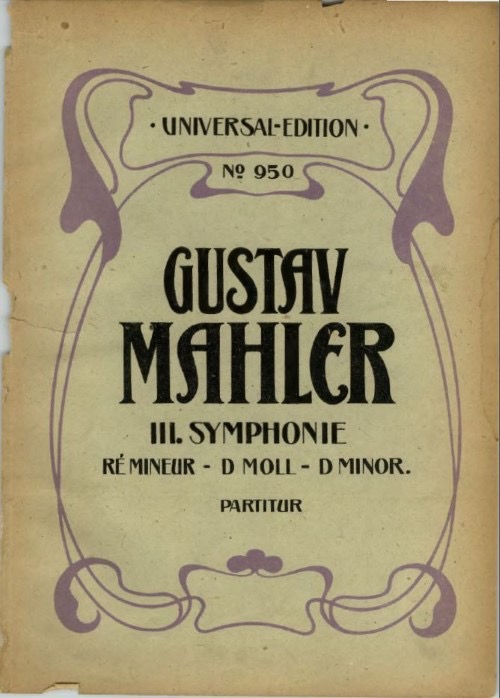
Symphony No. 3 in D minor
– in six movements
Composer: Gustav Mahler
Composed: 1896
Published: 1898
Premiered: June 9 1902, in Krefeld, Germany
Conductor: Gustav Mahler
Performers: Orchester des Allgemeines Deutschen Musikvereins
Movements
1. Kräftig. Entschieden (Strong and decisive) D minor to F major
2. Tempo di Menuetto Sehr mässig (In the tempo of a minuet, very moderate) A major
3. Comodo (Scherzando) Ohne Hast (Comfortable (Scherzo), without haste) C minor to C major
4. Sehr langsam—Misterioso (Very slowly, mysteriously) D major
5. Lustig im Tempo und keck im Ausdruck (Cheerful in tempo and cheeky in expression) F major
6. Langsam—Ruhevoll—Empfunden (Slowly, tranquil, deeply felt) D major
Program notes to each movement
1. “Pan erwacht. Der Sommer marschiert ein” (Pan Awakens – Summer Marches In)
2. “Was mir die Blumen auf der Wiese erzählen” (What the Flowers and Meadows Tell Me)
3. “Was mir die Tiere im Wald erzählen” (What the Animals of the Forest Tell Me)
4. “Was mir die Nacht (der Mensch) erzählt” (What the Night (Man) Tells Me)
5. “Was mir dir Morgenglocken (Engel) erzählen” (What the Morning Bells (Angels) Tell Me
6. “Was mir die Liebe erzählt” (What Love Tells Me)
Recurring Series Room List (updated regularly)
Anton Bruckner, Symphony No. 5 in B-flat major WAB 105
4/3 Sergiu Celibidache, Radio-Sinfonieorchester Stuttgart 1.1 / 1
4/4 Sergiu Celibidache, Radio-Sinfonieorchester Stuttgart 1.2 / 2
4/5 Herbert von Karajan, Berlin Philharmonic 2.1 / 3
4/5 Sergiu Celibidache, Radio-Sinfonieorchester Stuttgart 1.3 / 4
4/8 Sergiu Celibidache, Radio Sinfonieorchester Stuttgart 1.4 / 5
4/11 Günter Wand, Berlin Philharmonic 3.1 / 6
4/12 Bernard Haitink, Vienna Philharmonic 4.1 / 7
4/13 Bernard Haitink, Vienna Philharmonic 4.2 / 8
4/17 Bernard Haitink, Vienna Philharmonic 4.3 / 9
4/18 Bernard Haitink, Vienna Philharmonic 4.4 / 10
4/18 Bernard Haitink, Vienna Philharmonic 4.5 / 11
Gustav Mahler Symphony No. 3 in D minor
4/19 Claudio Abbado, Vienna Philharmonic 1.1 / 1
4/20 Claudio Abbado, Vienna Philharmonic 1.2 / 2
4/21 Claudio Abbado, Vienna Philharmonic 1.3 / 3
4/22 Claudio Abbado, Vienna Philharmonic 1.4 / 4
 Sila Blume
Leave a comment