The Recurring Music Series aims to investigate the meaning, source, and relevance of music — piece by piece, time after time, and again.
Especially when it comes to music pieces, but also cinematic works, by the first viewing/listening the individual seems incapable of grasping the magnitude, and minuscule details of the work. Beyond the fact that different singers, instrumentalists, and conductors will undoubtedly deliver varied interpretations, the audience is inevitably exposed to the additional limiting factor of perceiving the piece for the first time. Something is bound to shift, open, adjust, or marinate when listening numerous times.
With this in mind, we are welcomed herewith to embark in listening again, and again, and again. The results will likely grow to the attentive ear, mind, and entire self.
We begin this experimental series by introducing a given symphony, and subsequently playing it several times in upcoming musicus, organicus rooms on Clubhouse.
Recurring Series Room List (updated regularly)
4/3 Anton Bruckner #5, Celibidache, Radio-Sinfonieorchester Stuttgart 1.1 / 1
4/4 Anton Bruckner #5, Celibidache, Radio-Sinfonieorchester Stuttgart 1.2 / 2
4/5 Anton Bruckner #5, von Karajan, Berlin Philharmonic 2.1 / 3
4/5 Anton Bruckner #5, Celibidache, Radio-Sinfonieorchester Stuttgart 1.3 / 4
4/8 Anton Bruckner #5, Celibidache, Radio Sinfonieorchester Stuttgart 1.4 / 5
4/11 Anton Bruckner #5, Wand, Berlin Philharmonic 3.1 / 6
4/12 Anton Bruckner #5, Haitink, Vienna Philharmonic 4.1 / 7
4/13 Anton Bruckner #5, Haitink, Vienna Philharmonic 4.2 / 8
4/17 Anton Bruckner #5, Haitink, Vienna Philharmonic 4.3 / 9
Recurrence brings intentionalities:
– more is discovered than the first listen
– comparison of varied interpretations by conductor and orchestra
– the state of the individual listener will change through garlic or no garlic, joy or suffering, a peaceful sleep or a difficult and aggressive conversation beforehand, thus changing what is heard from a particular listen.
Anton Bruckner
Symphony No. 5 in B Flat Major, WAB 105
I. Introduction, Adagio – Allegro
II. Adagio. Sehr langsam
III. Scherzo. Molto vivace (schnell) – Trio. Im gleichen Tempo
IV. Finale. Adagio – Allegro moderato
Musicians / Version / Recording Year
(1) Sergiu Celibidache, Radio-Sinfonieorchester Stuttgart
(2) Herbert von Karajan, Berlin Philharmonic
(3) Günter Wand, Berlin Philharmonic
(4) Bernard Haitink, Vienna Philharmonic / 1878 Haas / 1988
Structure, Instrumentation
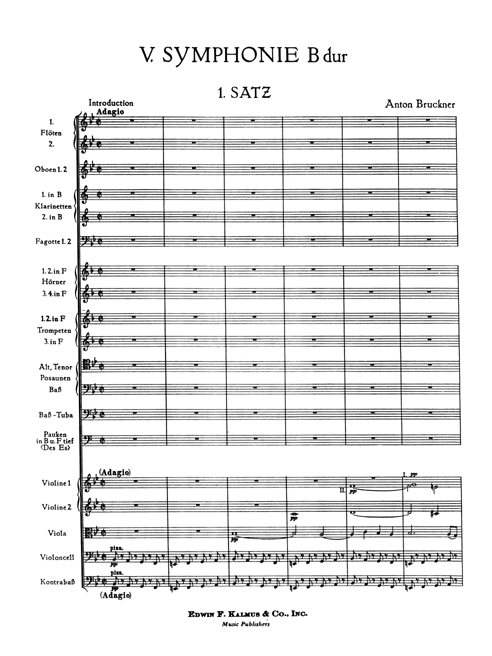
Bruckner began composing the Fifth Symphony in 1875 and finished it the following year. It’s the only one of his symphonies to start with a slow introduction, and he devotes the whole of the first movement to laying down the building blocks for the rest of the work. A stealthy pizzicato passage from cellos and basses is brought to a standstill by a full orchestral outburst. There is then a brief pause followed by a stately brass chorale and a fragment of what will become the Allegro. Again, a silence checks progress before the strings return. There comes another hiatus, a whisper from the strings, a brief intake of breath, and then the Allegro sweeps in. The first movement ends with a drum-roll punctuated by five emphatic chords which will be heard again much later in the coda to the finale.
Pizzicato chords introduce a second movement that is arguably Bruckner’s greatest Adagio. A plaintive oboe sings a sad song before we arrive at a soulful and noble melody for strings alone. However, Bruckner keeps his powder dry. There is no slow build-up to an awe-inspiring heavenly climax as in the Seventh and Eighth Symphonies. Instead, the music becomes increasingly fragmented until it disappears into silence, to be followed by the third-movement Scherzo, in which the composer puts on his dancing shoes in a cross between an Austrian Ländler and a Bohemian polka.
In all his previous symphonies, Bruckner had trouble with his finales, none of them totally satisfying, no matter which version or revision you hear. The finale of the Fifth was, then, something of a watershed for Bruckner, containing his most complex and innovative musical thoughts and set out like a huge mathematical puzzle. Chorale and counterpoint dominate throughout.
Like the first two movements, the finale begins with pizzicato strings. The hushed threnody which follows is interrupted by the clarinet, seemingly thumbing its nose at the orchestra. Fragments of the first two movements are then thrust aside by fierce lower strings, which announce the first fugue. We then get the familiar Brucknerian pattern – which tends to either delight or infuriate the listener – of hesitations, diversions, silences and the inevitable long build-up to a brass-drenched coda.
Bruckner, the fanatical revisionist, made only slight amendments to the score on this occasion. Perhaps for the first time in his chequered career, he believed he had just about got everything right first time round.
However, that didn’t prevent Ferdinand Löwe and the Schalk brothers, his well-meaning but misguided acolytes who were intent on getting Bruckner heard at all costs, from tampering with his original score. In 1894, Franz Schalk performed his own bastardised version in Graz. Mercifully, Bruckner was too ill to attend. He only ever heard his Fifth Symphony in a two-piano version by Josef Schalk and Franz Zottman, and it was not until 1935, 39 years after his death, that the original full orchestral score was performed in Robert Haas’s definitive edition.
Source: Classical Music
“All the joy and pleasure have gone out of my life; it seems utterly pointless and futile.”
Aton Bruckner
Begun in a mood of deep despair, the Fifth Symphony is Bruckner’s most astonishing triumph of mind over matter. Of all the Bruckner symphonies, it is the one least amenable to canonisation by those conductors convinced of the composer’s saintliness, but it does reveal most starkly its creator’s strength of spirit.
Circumstances were not encouraging in early 1875 when Bruckner began work on what was to be the slow movement.
Anton Bruckner’s Symphony No. 5 in B-flat major WAB 105, was written in 1875–1876, with minor changes over the next two years. It came at a time of trouble and disillusion for the composer.
Dedicated to Karl von Stremayr, education minister in the Austro-Hungarian Empire, the symphony has at times been nicknamed the “Tragic”, the “Church of Faith” or the “Pizzicato”; Bruckner himself referred to it as the “Fantastic” without applying this or any other name formally.
Bruckner is still frequently described as a ‘simple’ man, an Austrian peasant with little education and even less grasp of the sophisticated Viennese world in which he tried so desperately to establish both a living and a reputation. The facts tell a different story.
Bruckner may have appeared unpolished, at times bizarrely eccentric, especially to self-conscious Viennese sophisticates, but he was far from ill-educated. His father was a village schoolmaster – a background he shared with several of the greatest Austrian and German writers and thinkers. Bruckner went through a rigorous Catholic teacher-training programme, passing his exams with distinction the first time (a rare achievement in those days). Close friends and colleagues testify to his lively and enquiring intellect, as well as his friendliness and generosity.
Bruckner’s intense Roman Catholic faith certainly marked him out as unworldly. There are stories of him breaking off lectures at the Vienna University to pray; begging God’s forgiveness for unintentionally ‘stealing’ another man’s tune; dedicating his Ninth Symphony ‘to dear God’. However, tensions between the demands of his faith and his lifelong tendency to fall in love with improbably young women reveal a deep rift in his nature. Bruckner could also be alarmingly compulsive in his devotions –especially at times of acute mental crisis (there were plenty of those) – and there are hints he was prone to doubt, especially in his last years.
Source: London Symphony Orchestra
 Sila Blume
Leave a comment