Scenes from a Marriage
Television miniseries about the breakdown of a marriage that sent Sweden’s divorce rate soaring.
“It took two and a half months to write these scenes; it took a whole adult life to live.”
Ingmar Bergman
On 27 March 1972 Ingmar Bergman wrote in his workbook:
‘Here’s something we can do for the fun of it. It mustn’t cost too much, nor involve any financial risks. We’ll have lots of material to work with, as much as possible, I hope there will be an enormous amount. There’ll be plenty of exciting dialogue to get stuck into. Nothing at all out of the ordinary. I rather fancy a series of scenes from a marriage.’
On 4 May 1972 the Swedish broadsheet daily Dagens Nyheter announced that, for the first time in his career, Ingmar Bergman was to write and direct a television series. “Thematically”, Bergman explained, ‘the series will be a follow-on from or an adaptation of the two middle class tragicomedies I have made for the cinema and television, The Touch and The Lie. Like those, “Scenes from a Marriage’ (the working title of the proposed series), would deal with: ‘the absolute fact that the bourgeois ideal of security corrupts people’s emotional lives, undermines them, frightens them’.
‘Why television?’, Bergman was asked:
‘When you live on Fårö you become an avid television viewer. Television is quite simply the most amazing thing. It opens up the whole world. I watch the weather forecast every evening, the news, too. And I really enjoy the music and dance programmes – not to mention the ice hockey! When the world championships were on a few weeks ago, I certainly didn’t get much writing done on ‘Scenes from a Marriage’.’
The transition to television was to be almost absolute. Virtually all of Bergman’s films since Scenes from a Marriage have been made for television, whether series (Face to Face, Fanny and Alexander) or one-offs (The Magic Flute, Saraband). Admittedly, and for various reasons, they have all gone on cinema release, but they were intended for television. As Sven Nykvist has noted: ‘What Bergman has made for television are not simply films on television, they are television films.’ Bergman himself described Scenes from a Marriage as ‘an aesthetically superior everyday product for TV’.
By 27 May 1972, Bergman had finished the screenplay. The original took the same six-part format as the finished series: ‘Innocence and Panic’, ‘The Art of Sweeping Things Under the Carpet’, ‘Paula’, ‘The Valley of Tears’, ‘The Illiterates’ and ‘In the Middle of the Night in a Dark House Somewhere in the World’.
Bergman writing in Images:
Johan and Marianne became very real, very quarrelsome even. They had a good deal on their minds, and this form (straightforward dialogue without cinematographic complications) gave them natural occasions to speak out. I also discovered something else: that I was somewhat at odds with Johan and Marianne on many points. Yet despite this I realised that they should be allowed to speak out, just so long as I had the chance, at the end of the sixth episode, to say something that was very important to me personally.
Before I had time to reflect, there were six distinct dialogues about love, marriage and all manner of things besides. Johan and Marianne, or Marianne and Johan, had allowed themselves to be brave, cowardly, happy, sad, angry, loving, confused, uncertain, satisfied, cunning, unpleasant, childish, mean, unfathomable, magnificent, petty, physically affectionate, heartless, stupid, wretched, helpless: in a nutshell typical human beings.
Sources of inspiration
Scenes from a Marriage originates from the image of a successful and happily married couple sitting on a green velvet sofa being photographed for a magazine feature. This image provides the opening scene of the series. Bergman claimed to have met those people before. He had been friends with a Danish couple who were always pleasant, bountiful, and who never got drunk, just charmingly tipsy. They always said the right things, and even when they had the flu they still managed to be chirpy.
‘I remember they irritated me so intensely, that I once tried to seduce the wife (this is over twenty years ago). I failed, of course, and that made me even more annoyed. I did it in pure desperation just to bloody well show them. Suddenly I pictured them sitting in my old sofa and being interviewed. And I thought: ‘now I’ll get them’
Many people regarded Scenes from a Marriage as a new departure in Bergman’s work. No God, no Bergmanesque introspection, just a television series about ‘people like you and me’, as one journalist put it. Bergman concurred, recognising that it was the first time ’to his surprise’ that he had written something about people outside his own life: ‘I’ve used my own and other people’s experiences. But I haven’t projected myself and my own life into this.’
Yet when he was asked why it was that Scenes from a Marriage was so different from the Bergman films that people were used to, he replied: ‘Well, you know, you’re getting the same old bastard really. These are just some other things that have been there all the time, but have only just come up to the surface.’ Bergman’s interviewer continued along the same lines, light-heartedly questioning the non-appearance of God, neither in conversation, nor even disguised as a waiter or a gardener. ‘You’re absolutely right that God doesn’t feature,’ he replied. ‘But I’m far from a non-believer. I’m a believer in the truest sense. I believe in the sanctity of man.’
As cited above, Bergman himself did not feel any close affinity with Johan and Marianne, even though he did admit they shared some characteristics in common:
‘[…] such as our middle class background, with its double-edged impact on character development (that sounded good, didn’t it?). Both of them are academics, something which shouldn’t be a burden to them, and they’re well-off to the extent that they live in a house and each have their own cars and jobs. They’re also used to putting their thoughts into words, which doesn’t mean that they say the right things or that they are more honest or sagacious than other people in general.’
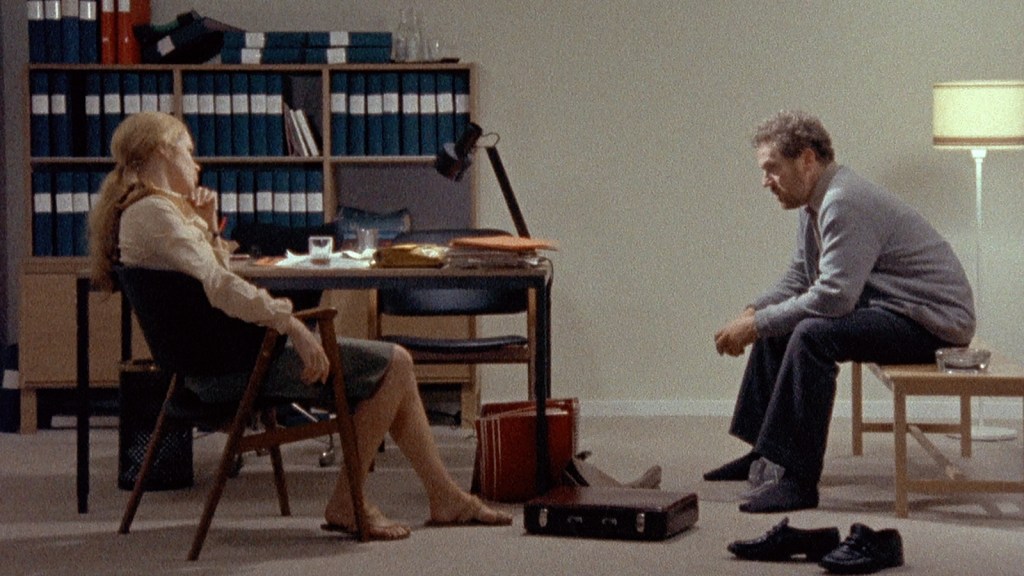
In the first episode Johan and Marianne have invited their friends Peter (Jan Malmsjö) and Katarina (Bibi Andersson) round for dinner. In Images: My Life in Film Bergman says of this couple: ‘Peter och Katarina cannot live with each other or apart. They commit cruel acts of sabotage against each other, actions that only two individuals this close could invent. Their time together is a sophisticated and destructive dance of death.’ The words ‘Dance of Death’ are particularly apt, since the shadow of August Strindberg can definitely be discerned in this picture of marriage as hell on earth. The couple have also been compared to George and Martha in Edward Albee’s classic Who’s Afraid of Virginia Woolf?, which Bergman had staged at the Royal Dramatic Theatre Dramaten in 1963.
Bergman has said that Scenes from a Marriage took ‘took a whole adult life to live’. At least one part of that life has a direct parallel in the series. In his autobiography The Magic Lantern Bergman recounts how he ran away from his wife to Paris with Gun Hagberg. He told his wife ‘everything’, he says, adding that: ‘Anyone interested can follow the events in the third part of Scenes from a Marriage. The only difference is the depiction of Paula, the lover. Gun was more like her opposite.’
Source: Ingmar Bergman
“Scenes from a Marriage” — Days with Ingmar Bergman *VII 14 1918 / The Life You Give
 Sila Blume
Leave a comment