‘Cries and Whispers” envelops us in a tomb of dread, pain and hate, and to counter these powerful feelings it summons selfless love. It is, I think, Ingmar Bergman’s way of treating his own self-disgust, and his envy of those who have faith. His story, which takes place inside a Swedish manor house on the grounds of a large estate, shows us a dying woman named Agnes and those who have come to wait with her: her sisters Maria and Karin, her servant Anna. Three men drift through, two husbands and a doctor, and there is a small role at the end for the pastor, but this is essentially a story of women who are bound together by a painful history.
This is a monstrous family. Maria (Liv Ullmann) is flighty and shallow, cheats on her husband, and refuses to come to his aid when he stabs himself after learning of her infidelity. Karin (Ingrid Thulin) is cold and hostile, hates her husband, cuts herself with a shard of glass in an intimate place and then smiles triumphantly as she smears the blood on her face. In one of the film’s most devastating scenes, Karin tells Maria how much she had always hated her.
Agnes (Harriet Andersson), the dying sister, has been caught in a crucible of pain. Sometimes she screams, wounded animal sounds, and then Anna (Kari Sylwan) comes to her, holds her head to her breasts, and tries to comfort her. Anna is the wholly good person in the movie, who prays to God for the soul of her dead daughter, and moves silently in the background as the family eats at its own soul. She loves Agnes, and would love the others if they could be loved.
Bergman never made another film this painful. To see it is to touch the extremes of human feeling. It is so personal, so penetrating of privacy, we almost want to look away. “Persona” (1966) points to it, especially with its use of closeups to show the mystery of the personality; no other director has done more with the human face. It’s as if “Cries and Whispers,” made in 1972, brought him to the end of his attempts to lance the wound of his suffering; his later films draw back into more realism, more sensible memories of his life and failings (for no director is more consistently autobiographical). And near the end there is “Faithless” (2000), directed by Ullmann from his screenplay, in which an old man summons actors (or ghosts) to help him deal with his regret for having hurt others.
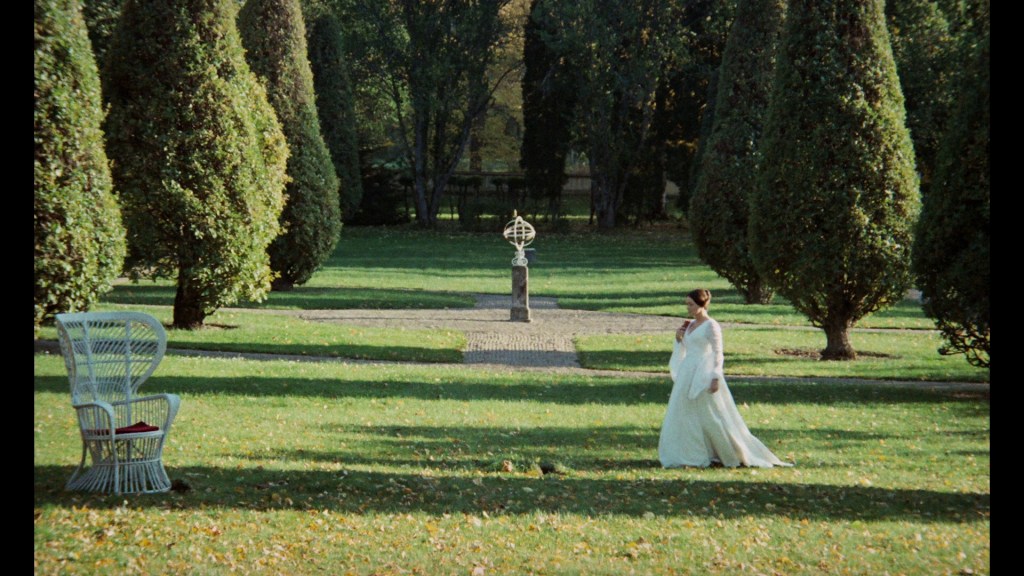
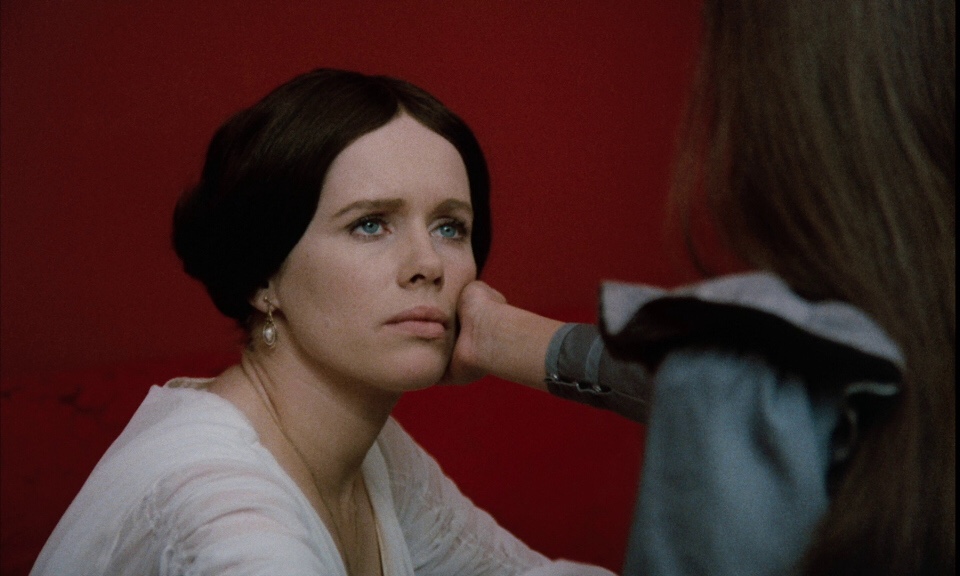
“Cries and Whispers” was photographed by Sven Nykvist, his longtime cinematographer, in a house where the wallpaper, rugs and curtains are all a deep blood red. “I think of the inside of the human soul,” Bergman writes in his screenplay, “as a membranous red.” The women are all dressed in old-fashioned floor-length white dresses or bedclothes, except after Agnes dies, when Karin and Maria change to black. In an essay with the DVD, the critic Peter Cowie quotes the director: “All of my films can be thought of in terms of black and white, except ‘Cries and Whispers.’ “ Yes, because the colors represent their fundamental emotional associations, with blood, death and spirituality. There are only a few respites. An opening shot looks out on the estate grounds, and there are brief sequences in the middle and at the end when family stroll through the green park. These moments release us briefly from the claustrophobic arena of pain and death.
Bergman uses flashbacks into the lives of the women, beginning and ending them with full frames of deep red, then fading into or out of closeups where their faces are half-illuminated. These flashbacks are not intended to explain biographical details, but to capture moments of extreme emotion, as when Maria wantonly seduces the doctor who has come to care for Anna’s child, or when Thulin triumphantly wounds herself to wound her husband even more.
One flashback involves both surviving sisters and their husbands, who cold-heartedly decide to reward Anna’s 12 years of faithful service with only “a small payment and a keepsake of Agnes.” Another scene shows Maria asking Karin if they cannot be friends, and Karin rebuffing her venomously, only to allow her sister, moments later, to caress her face. And then, in a scene where we see them talking but do not hear their words, the two women pet each other like friendly kittens, while expressing what look like words of endearment. When Karin later recalls this moment, Maria coldly rejects the memory.
Some deep wound has scarred this family. Agnes and Anna, never marrying, living together (possibly as lovers) in the family home, seem to have escaped it. Toward the end of the film there is an extraordinary dream sequence in which the dead Agnes asks first one sister and then another to hold her and comfort her. They reject her. Then Anna (whose dream it us) comforts her, in a composition that mirrors the Pieta. In this scene there seem to be shots indicating that Agnes has come back to life; they are ambiguous, until her hand clearly moves, but remember, it is a dream.
When “Cries and Whispers” was released, it had an impact greater than any other Bergman film except for “The Seventh Seal” and “Persona.” In an extraordinary achievement for a foreign film, it won Academy nominations for best picture, director, screenplay and cinematography. Oddly, it did not inspire a lot of complex interpretations, of the sort that have showered on puzzling recent films like “Memento,” “Mulholland Drive” or “Fight Club.” Perhaps that’s because it did not much appeal to young male viewers, who are the most enthusiastic theory-weavers, or perhaps it’s because the movie is simply beyond explanation: The emotions it portrays and evokes speak for themselves. It would be hard to say that any of the sisters, or any of their actions, “stand” for anything except the inexplicable way that life can bless and punish us.
Bergman, born 1918, the son of a Lutheran minister, was a lifelong agnostic (although in a conversation with Erland Josephson included on the new DVD, he says he hopes to see his wife in the next life). Spirituality is often at the center of his films, and usually involves the silence of God in a world of horror. The knight plays a chess game with Death in “The Seventh Seal,” and a Lutheran minister has a crisis of faith in “Winter Light” when he reflects on the possibility of nuclear holocaust.
In “Cries and Whispers,” Anna’s faith is simple and direct. She lights a candle, kneels before a photo of her dead girl, and asks God to love her. Then she blows out the candle and takes a healthy bite out of an apple (with perfect timing, intercepting some juice before it can fall). When Agnes dies, the scenes of the preparation of her body remind us of Biblical account of the women who took Christ down from the cross, and her cries of pain seem to ask the father why he has forsaken her.
The ending of the film is overwhelming in its emotional strategy. Anna is called before the heartless family, given her pittance, and told to be on her way. Offered a “keepsake,” she raises her voice for the only time in the movie: “I want nothing.” But later we find she has kept something. From a drawer she takes a parcel and unwraps it to reveal Agnes’ journal, and as she reads as Agnes recalls a perfect day in the autumn, when the pain was not so bad, and the four women took up their parasols and walked in the garden. “This is happiness. I cannot wish for anything better,” she writes. “I feel profoundly grateful to my life, which gives me so much.”
Anna’s keepsake is Agnes’ gratitude in the face of pain and death. When Karin and Maria come to the point of their deaths, we feel, they will be without resources, empty-handed in the face of oblivion. Bergman has made it clear from his other films that he feels imperfect, sometimes cruel, a sinner. Anna’s faith is the faith of a child, perfect, without questions, and he envies it. It may be true, it may be futile, but it is better to feel it than to die in despair.

The Boredom of Sickness in Cries and Whispers
One of the peculiar aspects of many films within Ingmar Bergman’s filmography is the manner in which he treats the objective and the subjective. In an earlier film of his, Through a Glass Darkly, Karin (Harriet Andersson) is a schizophrenic woman on the edge between the “real world” and her own subjectivity. Early in the film, she believes herself to be in a waiting room of sorts, waiting for God to appear to her. She knows he’s behind a door and she faces what she believes to be one, when it is in actuality a derelict wall of the summer home on Fårö, where the entirety of the chamber drama takes place. For a brief moment, she stares and it cuts from her face to a slow push up toward the wall. We get closer, and in that moment we have split between two realities: the camera pushing forward is literally her projecting fantasy onto the “real world,” which is what we see. Later in that same room, Karin sees God reveal himself, a Spider. The title, a quote from Corinthians, implies this stained vision, and Bergman provides sense-data which Karin interprets as proof of her delusion — the sound of the helicopter descending becomes the sound of God entering — birds in the distance become whispers speaking to her.
A rejection of symbolism in favor of textual associations becomes the directorial mode Bergman works within. He creates a system, and while some of these objects (like in the opening to Persona, Lermontov’s Hero of Our Time being read by the boy who read it in an earlier Bergman movie, The Silence) may have some association with other works by Bergman, they don’t represent or symbolize something outside of the text itself. When using the word “symbol” from here on, it is implied to mean a representation of something outside of the text itself (for instance, a character entering water symbolizing rebirth or the purification of spirit). “Association” is implied to mean something which recalls something in the text itself, like a leitmotif or key image. A famous example of this is one Sergei Eisenstein explains in Film Form, from Ivan the Terrible Part One. There is a shot of Ivan (Nikolay Cherkasov) being consoled by his mother, head in her lap. Fifteen minutes later in the film, he assumes a similar position with treacherous Boyars attempting to gain information from him. The association of the same position Ivan is in implies his vulnerability.
A still from Through a Glass Darkly. Karin lays her head down in an empty room, the frame is in black and white.
In viewing Bergman’s films over and over, I am reminded of a letter Andrei Tarkovsky transcribed at the beginning of Sculpting Through Time:
A woman wrote from Gorky: ‘Thank you for Mirror. My childhood was like that… Only how did you know about it? There was that wind, and the thunderstorm… ‘Galka, put the cat out,’ cried my Grandmother… It was dark in the room. And the paraffin lamp went out, too and the feeling of waiting for my mother to come back filled my entire soul… and how beautifully your film shows the awakening of a child’s consciousness, of this thought! … and Lord, how true… we really don’t know our mothers’ faces. And how simple… You know, in that dark cinema, looking at a canvas lit up by your talent, I felt for the first time in my life that I was not alone…
How are we supposed to meaningfully engage with this work from some intellectual distance? While I don’t doubt and plan to do my best to unravel Cries and Whispers and all the associations within it (at least some of them), it is dishonest to the work itself to not bring myself into it, especially as I know I too am less alone with it in this world.
This is at its heart a very simple story about a woman, Agnes (Harriet Andersson) who doesn’t yet want to die from her unnamed disease and her sisters who wait for the event to finally happen, Maria (Liv Ullmann) and Karin (Ingrid Thulin). They, along with the maid, Anna (Kari Sylwan), look over her, daydreaming about the past until she finally passes. Agnes remembers her mother and being jealous of her. Maria of an affair with David (Erland Josephson) and her husband Joakim’s (Henning Moritzen) subsequent suicide attempt, to which she shows little sympathy. Karin remembers a moment where she mutilates herself in front of her husband Frederik (Georg Årlin) and is immensely satisfied as a result. All of these incidents take place within the blood red walls of the aristocratic estate at the end of the 19th century.
A still from Cries and Whispers. Maria sits in a chair in an ornate red room, basking in the sunlight. Her two sisters sit behind her.
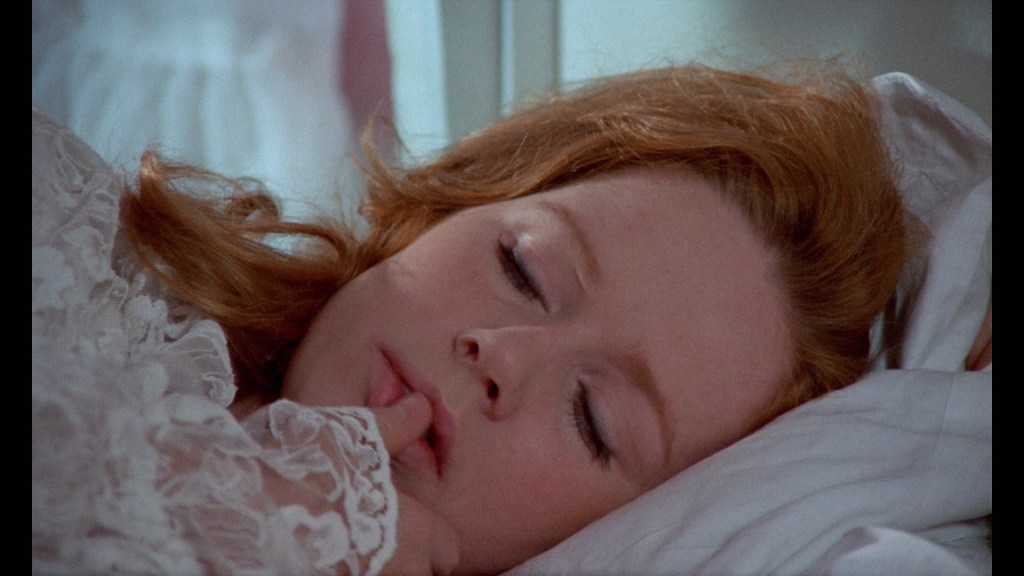
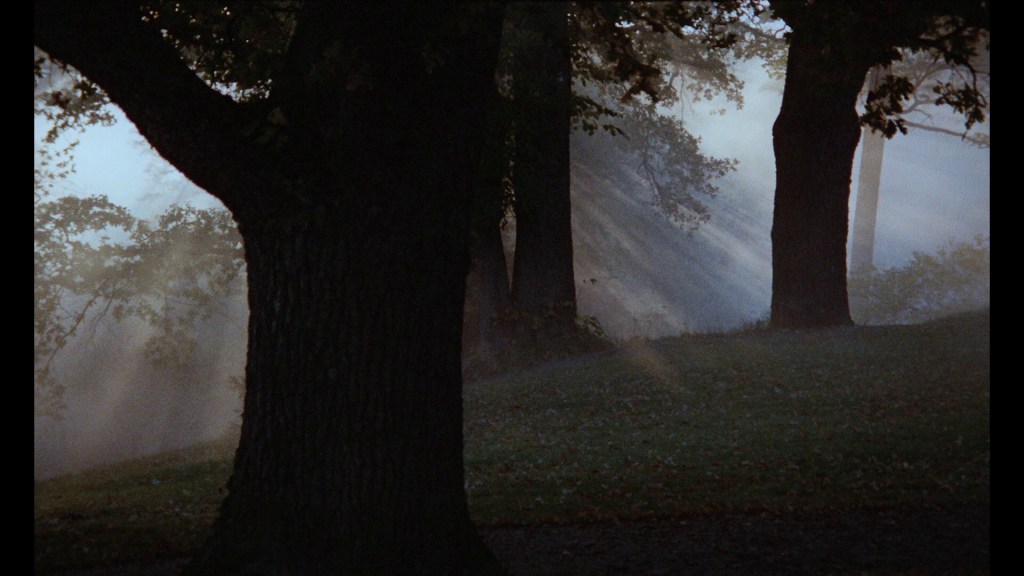
The film opens on the back of a statue of an angel. We are outside, surrounded by thick, old trees. There is a mist in the early morning. We fade to red and into a series of tilts and pans onto clocks within the home, the final one immobile in the room outside Agnes’ where Maria sleeps in a chair, failing at playing nightguard. Agnes wakes up in closeup, struggling to overcome her illness enough to face the day. She sits up and walks over to the clock, winding it before walking to the window, staring at the outside she is too weak to bring herself to. She walks to the door and sees Maria, fast asleep in the chair, the morning light so intense it blows out the top half of her head, appearing angelic. Eventually the smile fades. She sits at her desk and painstakingly writes, “It is early Monday morning and I am in pain.” After a lengthy pause, she continues: “My sisters and Anna are taking turns staying up.”
This opening, along with each moment of this film, is ripe for viewer projection. The angel could suggest some descent from grace, or the lack of the onlooking God, the ambivalence and nonsensicality of utter pain which echoes relentlessly throughout. A distance from the outdoors we briefly get to experience before remaining indoors for most of the rest of the movie. The mist reminds me of Tarkovsky’s work, in particular the opening of Solaris and the wind scene in Mirror. The clocks we return to over and over throughout the film, sometimes showing time passing, like when Agnes moans in her sleep from two in the morning until nine. Other times the ticking is simply there, a reminder of the burden of time. The closeup of her moaning in pain as she wakes up is horrible. It’s long and drawn out and realistic. She groans for a full minute before she is able to bring herself up to the clock, winding it, then to the window. The cut to the blind opening, revealing the outside is reminiscent of the push-in from Through a Glass Darkly. This point of view straddles that same line of subjective/objective, clearly being from her perspective, while far too static and jarring to not make it stand out – the outside becomes a place very distant for the majority of the rest of the runtime. It only appears again in the flashback to the mother (pretty briefly) and in the ending moments. She then walks between the two rooms, looking at her sleeping sister and smiling. The smile fades. Is this a moment of envy? Of jealousy perhaps, that which she expresses later in the flashback from her younger self? Or is she simply reminded again of the pain she’s experiencing and has experienced for the vast majority of her life? This aspect, the duration of illness and the projections it leads one to, is the central idea of the film itself. It is not only the plot (a patience piece where the audience waits for the sick woman to finally die, even then the waiting continues), but is the motivation behind long shots of prolonged agony like the one aforementioned, as well as the motivation behind the structure of the plot, the daydreams and listless nature of the characters.
This is what draws me to the film over and over. I am reminded of watching my father struggle to eat ice as he spent months in the hospital for pancreatic cancer. Of the tired secondhand embarrassment I felt when I was told to look out the window or leave the room when the nurse helped him defecate, similar to how the sisters feel toward Agnes, explicit when she speaks to them after her resurrection. They are disgusted, even if they demonstrate their disgust in manners fundamentally different from one another. They still have the ability to leave the situation, just as I did, flying from that Colorado hospital to finish my last semester of college in Chicago. Agnes cannot leave her condition, as my father was unable to, both dying. When I experienced six months of chemotherapy for hodgkin’s lymphoma, I too was unable to escape my condition. I empathize with Agnes when she wakes up, walking to the window and writing in her diary, “It is early Monday morning and I am in pain.” This is the constant, repetitive and ultimately boring irony of death and stasis — pain suspends time, lasting in the long term. Six months of laying in bed is a long time. I can’t imagine Agnes’ condition, having spent years sick, only able to imagine leaving the home in the state she finds herself in at the beginning.
A still from Cries and Whispers. A close up on Agnes, half of her face is obscured by a door.
The sisters experience two versions of the prolonged nature of pain – one is mentioned above, the listless waiting by those not afflicted by illness, only pity. Before my last semester I was to spend three days in between Denver and Boulder at the hospital. I didn’t watch my dad enter, I didn’t see him leave, I was there for a snapshot of time. I ignored the homework from my three week Spanish intensive I was missing out on to be there, as well as the manifesto I was supposed to write for an experimental production class. I found myself focused instead on writing poetry and depressing short stories, one being titled, “Ouroborus Biel,” about a man in a forest who eats himself from the fingers to the teeth. This listlessness triggers what makes up much of the first half of the film: the daydreams Maria and Karin return to, jogged by both the trauma of the moment as well as the estate they have returned to for the occasion. Maria remembers an affair and her husband’s subsequent suicide attempt. Karin a moment of self-mutilation in front of her husband. This pain they experienced, Karin’s physical, Maria’s psychological, returns to them, having lasted for years and years, if subconscious or invisible for much of the time. My own experiences with cancer, from perspectives of both observer and participant, functions similarly. Years later I remember moments vividly and they still hurt. I pass by the Walgreens parking lot where I received an unexpected phone call diagnosing my illness at least once a month, and it’s hard to not remember calling my mother to inform her that her son probably has the same illness she had 22 years prior.
This is, of course, the second version of pain experienced — the first hand view, that experienced by Agnes and myself. Her pain is made blunt in a variety of ways, of her writing at the beginning, “It is early Monday morning and I am in pain;” the envy with which she looks toward the outside or her more able bodied siblings; the feral horror expressed by her screams, unable to breathe. She is unable to escape it, the pain. Even dying won’t stop it, she’s stuck longer in her turmoil than the body seems able to take. This is the horrible truth of long term illness most do not understand: it grips you and overtakes your life for its duration, even past it. In the case of Agnes, its grip lasts for the major part of her life. Everything comes to a standstill come diagnosis. It’s stranger still when the illness one faces doesn’t create the pain one associates most with it.
In cancer, survivors like myself tend to (and not exclusively) remember the feeling of the treatment more than the cancerous bumps. We know the regular trip to the hospital and its procedure. Every two weeks the same thing. The shots and five valves of blood taken for the tests. The walk to the cubicle styled chemo room. Waiting for my friends to show up. Hanging out for an hour before connecting my chest port to the needle, flowing saline first, then the medicine. I would pass out after a half hour, usually. Rarely did I eat beforehand, so I was always hungry after I woke up. My friends and I would grab a bite to eat afterwards. I sometimes then shared my weed. I usually fell asleep early. Then I would attempt to watch movies/not push myself too far for a day or two, as I would throw up otherwise. I would then be able to concentrate enough on a movie or book to remember what I absorbed. The longer the routine went on, the easier it became to enter my familiar rhythm. I directed a few scenes from a short a day after my final chemo session, and though the peripheral neuropathy slowed me down quite a bit, I was competent enough to make it work.
A still from Cries and Whispers. The four women walk over fallen leaves, all wearing white and carrying lace parasols.
We see or hear the clocks in the house endlessly. When we are inside initially, the camera fades onto each clock, each with a different tone of tick. Mixed in the background as Agnes painfully wakes up is the relentlessness of time, the real horror of the patient. Up until many of us were locked up at the beginning of the COVID-19 pandemic, most had no clue what you do when immobile for such a long duration. Many even protested in April, unable to stand even a month of the “totalitarian measures.” For me it was familiar, as in contrast to chemo, there is some comfort in knowing everyone else is undergoing the same problem. I went to an art show not long after my diagnosis and afterwards broke down in tears, having been shocked at the normalcy of people not knowing what was going on within me. After I started chemo, most people, even if they didn’t know me, realized something was physically wrong with me and any normalcy projected onto me felt immediately false. I was extremely pale, lost sixty pounds and went bald. I never went outside, started smoking weed at 11 AM and became extraordinarily isolated. No one really knew what to do, as most of my friends were between twenty and twenty-three, most having graduated college before I began treatment. They didn’t know what they were doing with their lives and were trying their best to move forward, but I was stuck. I kept up the veneer of progress, frenziedly writing screenplays I couldn’t make, but I didn’t really talk to most people anymore. Some took my alienation personally, expressing disappointment at my lack of communication, or expecting me to be present for them when I could hardly be present for myself.
At the beginning of Cries and Whispers during Anna’s prayer, she trusts God had a reason for the taking of her child when she was far too young. She exits the room, the camera tilting down to the crib where the child must have slept. The film cuts then to Agnes, the juxtaposition implying Anna’s motherly love for Agnes, or, a responsibility to fill it since Agnes’ own mother has died. At the end, after Agnes is resurrected, she calls forth her sisters and asks for touch, to be accompanied before she finally enters that last sleep. Karin bluntly refuses, admitting to not loving her. Maria tries, but is overwhelmed with disgust, screaming as she runs out of the room. Only the inconsolable Agnes and Anna remain. The maid holds her up to her breast in maternal fashion. Is this judgement placed on Agnes’ soul? That she had been living a lie during this time? Is there some reason for her death, a part of God’s plan like the taking of an innocent child? Or is all that’s left memory echoing, the diary depicting a day when Agnes wasn’t in pain, able to go outside, enjoying the company of Anna and her sisters, writing: “Come what may, this is happiness. I cannot wish for anything better. Now, for a few minutes, I can experience perfection and I feel profoundly grateful to my life, which gives me so much.” One of a handful of optimistic moments in Bergman’s oeuvre, this is one through the perspective of Anna, having been dismissed by the family. She is left alone, able to take one possession of Agnes: her diary. This is the final thing she has left, Agnes’ memories made permanent, material.
Source: Film Cred, by Jack McCoy

 Sila Blume
Leave a comment