Renata Tarragó Fábregas is the guitarist and vihuelist (*) who was a teacher and performer, both as a solo artist and an accompanist. She was the first female guitarist to record Joaquín Rodrigo’s Concierto de Aranjuez, and was the editor of the first published edition of the Concierto de Aranjuez score.
Tarragó was born in Barcelona, Spain, October 23 1927, the second of two children of Graciano Tarragó, who was a musician, composer and teacher, and his first wife, Renata Fábregas. She studied at the Barcelona Conservatory, where her first teacher was her father. Graciano Tarragó (1892–1973), who had previously taught the soprano Victoria de los Ángeles, had studied the guitar under Miguel Llobet, and also played the violin and viola.
Renata Tarragó made her first public appearance at the age of 14, and was appointed an Assistant Professor at the Barcelona Conservatory upon the completion of her studies there in 1944. In 1951, the Barcelona Conservatory awarded Tarragó the “Premio Extraordinario” for her artistic accomplishments.
Renata Tarragó’s repertoire ranged from music written for the vihuela and Baroque guitar to that of the twentieth century. Among her solo recordings are the works of Federico Moreno Torroba, Francisco Tárrega, Fernando Sor, Gaspar Sanz, Johann Sebastian Bach, and Luigi Boccherini. In 1962, she made the first recording of Torroba’s Concierto de Castilla, accompanied by the Orquesta de Conciertos de Madrid, conducted by Jesús Arámbarri. Unlike the majority of classical guitarists, who play notes with their fingernails, Tarragó used her fingertips.
Tarragó concertized widely in Europe and abroad (including South Africa and the Soviet Union), and made her U.S.A. debut in 1960. In 1962, she represented Spain at the International Congress of the Guitar in Tokyo, and received a Gold Medal for her performances. During a 1962 concert at New York’s Town Hall, she played both the vihuela and guitar.
In the 1968 film Deadfall, she appeared onscreen playing John Barry’s Romance for Guitar and Orchestra in a concert scene, as well as on the soundtrack recording. The adagio from her recording of the Concierto de Aranjuez was used by Rex Nettleford and the National Dance Theatre Company of Jamaica for their dance piece, “Dialogue for Three”.
Source: Discogs

*
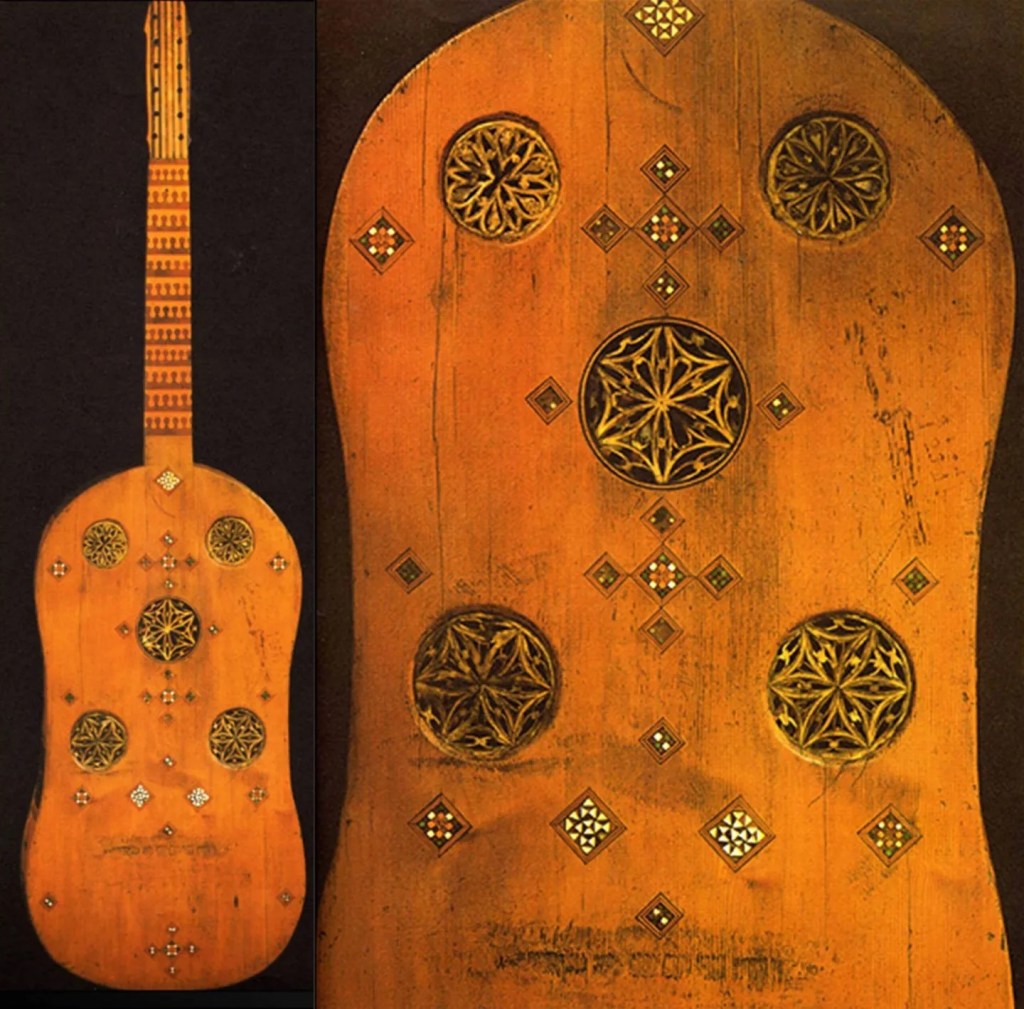
All players of early music will be familiar with the lute, the plucked polyphonic instrument par excellence of the European renaissance. In 16th century Spain, prime position was given not to the lute but to the vihuela da mano, depicted in Spanish iconography as the instrument of Orpheus, Arion, Venus, and the angels of heaven. The vihuela drew upon the polyphonic compositions of Europe for its intabulations, as well as having had its own repertoire in 7 books printed between 1536 and 1576 by such Spanish composers as Luis Milán, Luys de Narváez, and Alonso Mudarra. In 16th century Italy, where the lute was dominant, the vihuela was called the viola da mano, and was suggested as an alternative to the lute in two prints of the music of Francesco Canova da Milano, musician to three successive popes.
– Source: Early Music Muse
 Sila Blume
Leave a comment