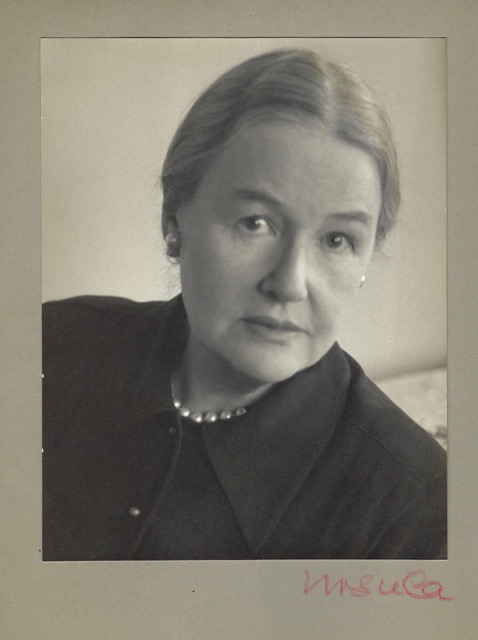
Rebecca Helferich Clarke, born on August 27 1886, is the classical composer and violist, internationally renowned as a viola virtuoso who also became one of the first female professional orchestral players in London.
In many respects, Rebecca Clarke had a troubled childhood. Her father maintained a strict sense of Victorian morals and could be quite cruel to his daughter. Nevertheless, Rebecca Clarke showed musical promise at an early age. She entered the Royal Academy of Music in 1903 to study violin but left abruptly after a marriage proposal from her harmony teacher. She enrolled at the Royal College of Music in 1907 as a composition student (the first female student of Charles Stanford) but left once her father removed his blessing. To support herself, Clarke began an active performing career as a violist. Clarke gained recognition as a composer after the premiere of her viola sonata in 1919. For most of her adult life, she split her time between Great Britain and the United States. Her works resemble those of other English composers from the early 20th century, conforming to the pastoral style in vogue. There is a clarity of texture throughout much of her music, as well as an impressionistic bent. Much of her music, to this day, remains unpublished.
Source: Music by Women
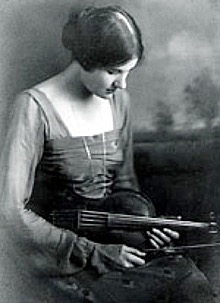
The self-styled ‘viola player and composer’ Rebecca Clarke (b. Harrow, England, 1886; d. New York City, 1979) played violin until her composition teacher, Sir Charles Stanford, urged her to shift over to the viola because then she would be ‘right in the middle of the sound, and can tell how it’s all done. ’ The viola became basis of Clarke’s world-wide career as a soloist and as a partner in chamber music with many of the greatest artists of the early twentieth century, including Schnabel, Casals, Thibaud, Rubinstein, Grainger, Hess, Monteux, and Szell.
Clarke’s compositional output was brilliant out of all proportion to its bulk (about 100 works, including juvenilia). Her Viola Sonata and Piano Trio are often played and recorded, and are now generally regarded as masterpieces. Her mature songs – perhaps her finest body of work, running the gamut from Blakean simplicity to brutal tragedy to outright farce — are also widely performed and recorded. Her choral and vocal-ensemble music was virtually unknown until publication of her Ave Maria and Chorus from Shelley’s ‘Hellas’, but has since been performed and recorded. Several of her shorter instrumental chamber pieces, especially Morpheus, Two Pieces for Viola (or Violin) and Cello, and Prelude, Allegro, and Pastorale, have been performed, recorded, and broadcast worldwide.
Source: British Music Collection
 Sila Blume
Leave a comment