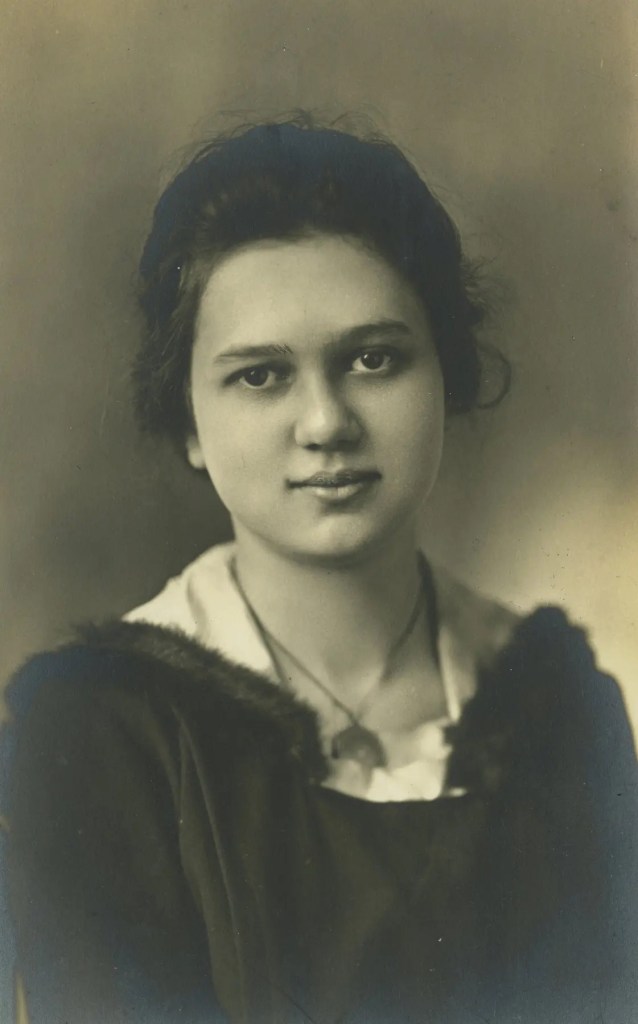
Ruth Crawford Seeger, born July 3, 1901, in East Liverpool, Ohio, U.S.A., studied piano as a child and was self-taught as a composer until she entered the American Conservatory. After early works influenced by Alexander Scriabin, she wrote several astonishing serial pieces, including her String Quartet (1931). She married the musicologist Charles Seeger (1886–1979) in 1931, becoming folk singer Pete Seeger’s stepmother. She composed little after that but became an influential curator of American folk music.
Source: Britannica
Ruth Crawford Seeger enjoyed a two-part career, first as an experimental composer in the 1920s and early 1930s, and then as an American folk music specialist in the last several years of her life.
Born in Ohio, Crawford received early musical training in Jacksonville, Florida, moving to Chicago in the early 1920s to study at the American Conservatory of Music. It was here, in 1926, that she met poet Carl Sandburg, with whom she later collaborated on his collection of folksongs The American Songbag.
Crawford played an important role in the Modernist movement in the 1920s and was named to the boards of a number of important new music societies (including Henry Cowell’s New Music Society, as well as the Pro Musica Society). Crawford was extremely prolific as a composer between 1924 and 1929, and her music was performed quite often during those years, especially her Violin Sonata and works for piano. In 1928, three of her piano preludes were featured in the Copland-Sessions series in New York.
In 1929, Crawford moved to New York to study composition with Charles Seeger, a musicologist and composer, helping him with revisions to his work Tradition and Experiment in New Music and a Manual on Dissonant Counterpoint. In 1930, she became the first woman to win a Guggenheim Fellowship, and her travels took her to Berlin and Paris. Though she purposely did not study with Arnold Schoenberg, she was greatly influenced by her meetings with Berg and Bartók while abroad. After returning to America in 1931, she married Charles Seeger.
In 1936, Charles and Ruth moved to Washington D.C., and Ruth began working for the Archive of American Song at the Library of Congress. Essentially, Ruth stopped composing during this period, but her transcriptions of American folk songs became well known in her 1941 publication Our Singing Country. Other important publications of this nature include American Folksongs for Children (1948), Animal Folksongs for Children (1950), and American Folk Songs for Christmas (1953).
The influences on Ruth Crawford Seeger’s music are eclectic, and include not only her early Modernist leanings, but her connections to American transcendentalism (through Sandburg), as well as her fascination with Native American traditions and Eastern Mysticism. Some have labeled her as a bridge between the transcendentalist and Modernistm movements.
–Christie Finn
(Source: Grove Dictionary of Music and Musicians)
Source: Song of America

 Sila Blume
Leave a comment