Edouard Manet’s last major work was the Bar at the Folies Bergere, exhibited at the Salon in 1882 (the year before Manet’s death). Manet’s Luncheon on the Grass (Dejuner sur l’herbe) was shown at the Salon de Refuses in 1863. Like Olympia, shown two years later, it was roundly rejected by art critics and the public.
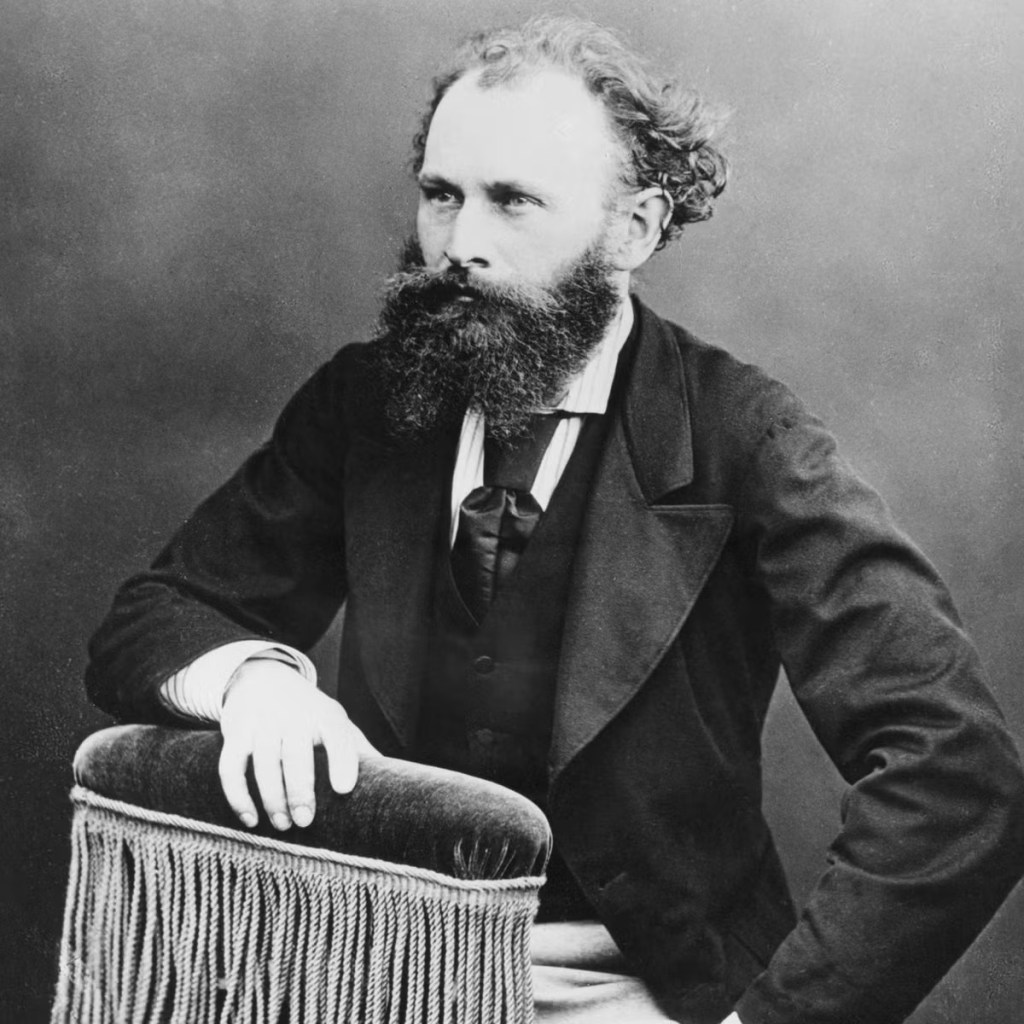
Manet was, unlike many of the other impressionists, born into a wealthy bourgeois family: his father a senior civil servant and later a judge; his mother the goddaughter of the Swedish crown prince.
Manet’s roots were a blessing and a burden: he did not have to worry about money, being left a substantial inheritance on his father’s death in 1862, and so could paint his way without having to worry about sales.
But his desire to please his father and justify his career choice after his father’s death meant that he never stopped trying to gain recognition at the Salon, the official exhibition put on by the French state each year—with only limited success.
Manet died when he was only 53. But his fascinating life saw him sail to Rio de Janeiro on a merchant ship, become a household name in France when he took on the conservative art establishment with a painting of a prostitute, defend Paris when the Prussians laid siege to it in 1870/1, and even fight a duel.
These days Claude Monet is probably more famous than Manet. But the latter was seen as the father of Impressionism during his lifetime: he gave the other impressionists the confidence to take on the conservative art world. Indeed, Manet’s most controversial work—Olympia—was probably the first true work of modern art.
Manet studied in the studio of Thomas Couture between 1850 and 1856. The two did not always get on. Manet’s first submission to the conservative Salon of the Academy des Beaux Arts, in 1859, was the Absinthe Drinker. It did not find favour, with only one of the 12 jurors voting for its admission.
Manet was not academic: at school he achieved average grades in everything except art and gymnastics. This displeased his father, who wanted his eldest son to follow him into the law.
His artistic desires were instead encouraged by his mother, with whom he was very close, and his maternal uncle, Édmond Fournier (who often took Manet and his best friend, Antonin Proust, to the Louvre). Refusing to study law led to arguments with his father and, eventually, a compromise by which it was agreed that Manet would become a naval officer.
But the 16 year-old Manet failed his naval exams and ended up on a merchant ship, called Havre et Guadeloupe, bound for Rio de Janeiro (the voyage lasted from 8 December 1848 to 13 June 1849). The idea was that Manet would study for his re-sits on board.
The crossing was eventful. Manet was tossed around the ship during storms; spent days watching the water and the clouds; engaged in a maritime ritual for sailors passing the equator for the first time; went to the Rio carnival; was bitten by a snake; drew caricatures (which the ship’s captain used as Christmas presents); and gave the crew painting lessons. He also resolved not to be a sailor.
On his return, Manet duly failed his re-sits and was eventually allowed to enrol in a painting school run by the classical landscapist Thomas Couture, where he spent six years — between 1850 and 1856. Over this period he copied old masters and started to develop his unique technique. He respected Couture, who encouraged his students to develop their own style.
On occasion Manet and Couture quarrelled. Once, Manet stormed out of Couture’s studio in protest about a critical remark and refused to return for a month!
After leaving Couture’s in 1856, aged 24, Manet opened his own studio and after a few years produced his first major work: the Absinthe Drinker. It is a grand painting depicting a poor Parisian drunkard. And it was Manet’s first submission to the annual Salon (Exhibition) organised by the influential Academy des Beaux Arts (Fine Arts Academy).
In a time where there were few private exhibitions, the Salon was critical to the success or failure of an aspiring artist. Acceptance by the jury and positive reviews in the papers would lead to commissions and sales. Rejection or negative commentary could stop a career in its tracks.
The 1859 jury did not take to The Absinthe Drinker, which received the approval of only one the twelve jurors (that of the romantic painter Eugène Delacroix).
When Manet turned to Couture for comfort he got none. Couture remarked that:
“the only drunk around here is you!”
Manet’s first Salon success was with the Spanish Singer, for which he received an honourable mention in 1861. He was not to achieve any further Salon success for another 20 years!
Monet’s Dejuner Sur l’Herbe (Lunch on the Grass) sparked uproar when it was shown at the Salon des Refuses in 1861: the public were not used to art depicting risque modern scenes.
The defiant gaze of Olympia, shown at the Salon in 1865: she wasn’t going to apologise for her way of life! The public outrage was so extreme that Manet travelled to Spain to escape from it. By 1867, he was so desperate to show his works that he paid for the construction of his own pavilion so that his works could be seen by the worldwide audience attending the World Exhibition in Paris.
For the 1861 Salon, Manet submitted two works: an unsentimental portrait of his parents (Portrait of Monsieur and Madame Monet), and The Spanish Singer.
The former shows his father looking stern and authoritative, though it was actually produced the year after he had suffered a severe stroke. The latter, of a slightly gormless looking street entertainer, won an honourable mention—probably because Spanish subjects were fashionable at the time.
Manet was not to receive any further praise from the jury for another two decades!
Manet then had a stroke of luck.
The jury for the 1863 Salon was particularly harsh, rejecting two-thirds of the works that had been submitted. News of discontent amongst artists reached Emperor Napoleon III who, sensing a political opportunity, declared that an Exhibition of the Refused should be held so that the public could judge the rejected art for itself.
The public attended the “Salon des Refuses” in their droves. But they came to be entertained and not to admire. Manet’s painting was singled out for particular ridicule, with critics questioning whether it had been painted with a mop and whether the work was Manet’s idea of a practical joke.
In fact, the real surprise is that Olympia was accepted by the jury for the 1865 Salon. Perhaps they thought that the criticism Manet would inevitably receive would chasten the young man.
But Olympia was not all bad: Manet had shown that he was willing to stand up to the establishment, which encouraged the other impressionists to do likewise; and now everybody in Paris knew his name.
He penned an emollient foreword to his exhibition catalogue.
The foreword was Manet’s attempt at conciliation with the conservative art establishment. He said this:
“The artist today is not saying ‘Come and see my faultless work’ but ‘Come and see my sincere work’. … Monsieur Manet has never wished to protest. Rather, people have protested against him. … Monsieur Manet presumes neither to overthrow earlier painting nor to remake it. He has merely tried to be himself.”
The venture was a failure in financial terms. The most that can be said about it is that it solidified Manet’s position as the leader of the impressionists, a man who was happy not to conform.
Manet could not help being controversial.
He was an opponent of Napoleon III and, when his puppet ruler of Mexico, Emperor Maximilian, was executed and the French ’empire’ of Mexico collapsed he could not help but produce a painting recording events.
Since criticism of Napoleon was not allowed, Manet could not exhibit the paintings in France (though one of the large canvasses appeared in America) and Manet was refused permission to make lithographs of them.
Manet loved Paris and going to its cafes. He adored people, people watching, debating political and artistic ideas, and making people laugh. The impressionists frequented two cafes in particular: the Cafe Guerbois and later the Cafe Nouvelle Athens.
It was here that a number of the members of the impressionist circle could be found in the early evening. In addition to Manet, they included Renoir and Degas (and sometimes Monet), and writers such as Emile Zola. The Manet and Morisot families were in the same social stratosphere. The matriarchs of both families got on. And Manet was taken with the intellect and looks of the Morisot’s elder daughter, Berthe.
The two became very close in the late 1860s and beyond, though how close remains debatable. Manet appears to have fallen in love with Berthe, and certain of her correspondence appears incriminating (whilst many letters written by Berthe to her sister, Edma, were destroyed at Berthe’s request). My guess is that they had an affair.
Ultimately, Manet’s way of moving on was to engineer Berthe’s marriage to his younger brother Eugene, which took place after an on/off courtship in 1872. Over this period Manet repeatedly painted Berthe. The results were sometimes flattering, sometimes not, and on one occasion unusual and indeed sensual (Berthe is captured lying provocatively on a feinting couch in Berthe Morisot Reclining).
Strange as it may sound, Manet duelled with an art critic friend of his, Louis Edmond Duranty, in February 1870.
The altercation started when Duranty penned an ambiguous review of Manet’s submissions to the Salon that year. Manet was furious: if he couldn’t count on his friends to write positive reviews, the impressionists had no chance. He burst into the Cafe Guerbois, slapped Duranty, and demanded a sword-duel.
It took place the next day, in the Forest of Saint-Germain. Neither man was adept at fencing. And after Manet managed to wound Duranty in the upper chest, the duellers’ ‘seconds’ (ie the men who would take their place in the event of injury) declared that honour had been satisfied.
Manet and Duranty became friends again before too long.
In late 1870, Napoleon III embarked on a misconceived military campaign against the Prussians.
The ill-equipped French forces were soon defeated and Paris surrounded. But the proud Parisians would not give up their city without a fight. They barricaded themselves in.
Not everyone stayed. Whilst Manet refused to leave, and indeed joined the army, other impressionist colleagues were not so patriotic. (Cezanne refused to be conscripted and hid from the authorities in a fishing village near Aix in southern France; and Monet, Sisley and Pissarro moved to London.) In contrast, Renoir was conscripted (though he did not see action) and Bazille was killed in battle.
The Prussians were supremely confident, joking that:
“The Parisians won’t last a week without their cafe au laits!”
How wrong they were: Paris lasted over four months before she eventually surrendered (between 19 September 1870 and 28 January 1871). All faced hardship (even the elephants at the zoo were slaughtered for meat) and many died of starvation, disease or from the incessant shelling.
Manet, having done his duty, went to the seaside town of Archachon, near Bordeaux, to recuperate.
The 1873 Salon: The Good Beer
For the 1873 Salon, Manet submitted a portrait of a working class Parisian man smoking his pipe and enjoying his beer.
Called Le Bon Bock (The Good Beer) Manet for once judged the mood of the jury and the public.
The work was seen as an icon of solidity and solidarity in the uncertain times following the disastrous Prussian war and the fall of the Third Empire. Soon, it started appearing all over Paris, including in gift shops and as the name of a pub.
Manet also managed to make a rare sale, to the opera singer Jean-Baptiste Faure for the very considerable sum of 5,000 francs.
1874: Manet paints with Monet
Manet had been seen as the leader of the impressionists from the mid-1860s. He stood up to the establishment, socialised with and was admired by the rest of the group, and often doled out money when needed.
Manet was initially reluctant to paint en plein air (outdoors): even though his works use broad strokes, he was a perfectionist (often requiring models to sit on scores of occasions for a single work).
But Berthe Morisot persuaded him to give it a go and in 1874, Manet painted with Renoir and Monet at the latter’s house in Argenteuil.
Interesting fact…
The result was that Manet’s paintings became lighter and brighter, though he did not abandon his use of black (a colour avoided by the other impressionists). Indeed, some of Manet’s open air paintings bear a striking resemblance to Monet’s works.
Despite this pollination, and his financial and pastoral support for the group, Manet never exhibited at the eight independent impressionist exhibitions held in and after 1874. He instead continued to challenge the Salon’s jury.
1874: Masked Ball at the Opera
The 1873 success enjoyed by Manet turned out to be an aberration: the next year the jury rejected one of his most important works, Masked Ball at the Opera.
True it is that Manet was, through this painting, having a dig at the establishment. The masked ball was a high society occasion of low morals: it was attended by actresses, showgirls and courtesans. The jury probably worried that they would be identified among the male revellers (who in fact are modelled on Manet himself and his friends).
But the work is an absolute masterpiece. It has the shimmering black of top hats and dinner jackets; it evokes feelings of movement and merriment (even debauchery); it uses splashes of bright colour; and it has the usual tongue-in-cheek finishing touches (see the stockinged legs hanging from the balcony).
1876: Manet’s own show
Manet’s two submissions for the 1876 Salon were once again rejected. One member of the jury is reported to have said:
“we have given Manet a decade to turn over a new leaf, but he refuses to do so. In fact, he grows worse”.
The offending works were The Laundry (a heart-warming work of a mother and daughter sorting washing in the garden) and The Artist (a portrait of the Bohemian Gilbert Marcellin Desboutin).
Manet’s reaction was different from before: he decided to stage his own exhibition at his studio. Formal invitations were sent with the motto
“Make it truthful and let them say what they like.”
Four thousand people came. But only a few minds were changed.
One of the few was Mary Laurent, a famous actress, who became close friends with Manet and posed for a number of his paintings.
1877: the Nana scandal
In 1877, Manet returned to the subject of prostitution.
His work, Nana, depicts a famous grand-cocotte, Henriette Hauser, in a corset and petticoat looking at the viewer. She is in her boudoir applying make-up. The painting is life-sized and all the more shocking because Henriette was the mistress of the Prince of Orange (a principality in southern France).
Debating point….
Though not as brazen as Olympia, Nana is in no way apologetic. She is seemingly getting ready for a night out and ignoring a well-dressed gentleman—her client?— sat on the painting’s far right.
After its rejection by the jury, Nana was displayed in the window of an art dealer, Giroux, in the Boulevard de Capucines. Hundreds flocked to see it and the police were called when it looked like a riot would break out.
EXPAND TO READ MORE
5. The 1880s
Exhibited at the Salon des Beaux Arts in 1882, Manet’s portrait of Henri Rochefort received a second class medal. It gave Manet some of the recognition he had been craving since 1859.
Manet’s last major work was the Bar at the Folies Bergere. Normal service was resumed: the public were puzzled by the painting’s use of perspective and reviews were mainly negative.
Manet died in 1883, but not before he had won a medal at the Salon, received an honour from the French state, and exhibited one of his most important and puzzling works: the Bar at the Folies Bergere.
The 1881 Salon: recognition at last
Manet did not exhibit at the impressionist exhibitions because he craved official recognition.
He wanted to take on and beat the art establishment; and he wanted, almost two decades after his father’s death, to justify his controversial career choice.
Recognition finally came in the form of a second class medal awarded by the 1881 jury, for a portrait of a previously exiled revolutionary called Henri Rochefort. Eight other second class medals were awarded, with no entry considered first class material.
The award also allowed Manet’s boyhood friend, Antonin Proust, to award him the legion d’honneur in December 1881. By this stage Proust was minister for fine arts.
The award came just in time: the government fell months later and Proust lost his position!
The 1882 Salon: the Folies Bergere
Normal service was resumed in the 1882 when Manet submitted the Bar at the Folies Bergere to the Salon.
This was his last major work and is classic Manet: predominantly a portrait, it shows electric lighting and one of the hottest new nightspots in his beloved Paris, with bright colours, broad brush strokes and a dollop of enigma.
The thing that confounded critics and the public at the time and still puzzles is the reflection of the barmaid, Suzon, in the large mirror found behind the bar. It seems to defy the laws of physics!
But it was quite intentional and Manet’s way of being controversial and introducing the top-hatted gentleman in seemingly intense conversation with Suzon.
Interesting fact…
Who is the man in the Folies Bergere: a patron, lover, disapproving father or someone else entirely?
The Folies Bergere was painted from a specially constructed bar in Manet’s studio. He was, by 1882, too ill to travel to the bar for sittings.
1883: Manet’s last illness
By the time he submitted the Folies Bergere, Manet’s health was failing.
Though he had denied it for a number of years, he had tertiary syphilis that was robbing him of his motor skills.
The regimens prescribed by his doctors, which mainly involved bathing in spas, had not worked. And by late 1882 he was struggling to walk. He painted still lifes—mainly flowers—in his last months, socialised and read books to take his mind off the pain.
In the end, his left foot became gangrenous and his left leg was amputated below the knee. He struggled on for another fortnight, dying on 30 April 1883 aged 51.
Manet’s pallbearers included Monet, the critic and writer Émile Zola and Manet’s lifelong friend Antonin Proust.
Following the procession, Edgar Degas was heard to remark:
“he was even greater than we thought.”
EXPAND TO READ MORE
6. Manet’s Legacy
Manet’s 1862 painting Music in the Tuileries was a precursor of his far more famous Dejuner Sur l’Herbe.
Manet painted with Monet at Monet’s house in Argenteuil in 1874. This work, the Seine at Argenteuil, closely resembles Monet’s output.
Manet’s painting of a mother and daughter at the Gare Saint Lazare was produced in 1873
Manet was in many ways the leader of the impressionists.
Manet’s legacy
He showed them how to believe in their new ways of painting in the face of official opposition and ridicule from the critics.
It helped that Manet was slightly older than most of the others; that he was independently wealthy and so able to provide financial support when times got tough; and that he was fashionable, urbane and witty.
Manet’s own output is unique. It plays with colour, perspective and the laws of physics. It challenges social conventions. Many of his works—for instance Dejuner Sur l’Herbe, Olympia, and the Bar at the Folies Bergere—are world famous today.
Indeed, most experts agree that Olympia was the first true work of modern art.
Édouard Manet *I 23 1832 — The Life you Give
 Sila Blume
Leave a comment