Siegfried is a figure from the heroic literature of the ancient Germanic people. He appears in both German and Old Norse literature, although the versions of his stories told by these two branches of the Germanic tradition do not always agree. He plays a part in the story of Brunhild, in which he meets his death, but in other stories he is the leading character and triumphs. A feature common to all versions is his outstanding strength and courage.
One story tells of Siegfried’s fight with a dragon, and another of how he acquired a treasure from two brothers who quarreled over their inheritance. These two stories are combined into one in the Norse Poetic Edda and told in detail, whereas in German literature, where they are kept entirely separate, the information is scant and largely contained in allusions.
Opera, Blood, and Tears
celebrates the premiere of
Siegfried
– Second day in the Ring of the Nibelungen,
by Richard Wagner
August 16 at 3 pm EST
on Clubhouse
Siegfried plays a major part in the Nibelungenlied, where this old material is used but is much overlaid with more recent additions. “Das Lied vom hürnen Seyfrid”, not attested before about 1500, also retains the old material in identifiable form, although the poem’s central theme is the release of a maiden from a dragon; and an Edda poem tells how Sigurd awakened a Valkyrie maiden from a charmed sleep. Here, too, many critics have tried to establish a connection between German and Norse; but besides important differences, there is doubt about the antiquity of both poems.
In the original stories Siegfried was presented as a boy of noble lineage who grew up without parental care; this background shows through clearly, although in the full accounts in both Norse and German it is overlaid with elaborate accounts of his courtly upbringing. It is still disputed, as with Brunhild, whether the figure of Siegfried is of mythical or historical (Merovingian) origin.
Source: Britannica
Siegfried, WWV 86C, is the second day, and the third of the four epic music dramas that constitute Der Ring des Nibelungen (The Ring of the Nibelung)
Music: Richard Wagner
Libretto: Richard Wagner
Based on: Nordic and German legends
Premiere: Bayreuth Festspielhaus, on August 16 1876, as part of the first complete performance of The Ring cycle.
Siegfried is the son of Sieglinde and Siegmund
Roles:
Siegfried (Tenor)
Mime (Tenor)
Der Wanderer / Wotan in disguise (Bass-bariton)
Alberich (Bass)
Fafner (Bass)
Erda (Contralto)
Brünnhilde (Soprano)
Voice of the wood-bird (coloratura Soprano)
Synopsis
Act 1
Scene 1
A cave in rocks in the forest. An orchestral introduction includes references to leitmotifs including themes relating to the original hoard plundered by the Nibelung Alberich, and one in B flat minor associated with the Nibelungs themselves. As the curtain rises, Alberich’s brother, the dwarf Mime, is forging a sword. Mime is plotting to obtain the powerful ring originally created by his brother Alberich for himself. He has raised the human boy Siegfried as a foster child, to kill Fafner, who obtained the ring and other treasures in the opera Das Rheingold and has since transformed himself from a giant to a dragon. He needs a sword for Siegfried to use, but the youth has contemptuously broken every sword Mime has made. Siegfried returns from his wanderings in the forest with a wild bear in tow, and immediately breaks the new sword. After a whining speech by Mime about ingratitude, and how Mime has brought him up from a mewling infant (“Als zullendes Kind”), Siegfried senses why he keeps coming back to Mime although he despises him: he wants to know his parentage. Mime is forced to explain how he took in Siegfried’s mother, Sieglinde, who then died, giving birth to Siegfried. He shows Siegfried the broken pieces of the sword Nothung, which Mime had obtained from her. Siegfried orders him to reforge the sword; Mime, however, is unable to accomplish this. Siegfried departs, leaving Mime in despair.
Scene 2
An old man (Wotan in disguise) arrives at the door and introduces himself as the Wanderer. In return for the hospitality due a guest, he wagers his head on answering any three questions of Mime. The dwarf asks the Wanderer to name the races that live beneath the ground, on the earth, and in the skies. These are the Nibelung, the Giants, and the Gods, as the Wanderer answers correctly. The Wanderer then induces Mime to wager his own head on three further riddles: the race most beloved of Wotan, but most harshly treated; the name of the sword that can destroy Fafner; and the person who can repair the sword. Mime answers the first two questions: the Wälsungs (Siegmund and Sieglinde whose tale is told in the opera Die Walküre) and Nothung. However, he cannot answer the last. Wotan spares Mime, telling him that only “he who does not know fear” can reforge Nothung, and leaves Mime’s head forfeit to that person.
Scene 3
Mime despairs as he imagines the ferocity of the dragon Fafner, while “the orchestra paints a dazzling picture of flickering lights and roaring flames”. Siegfried returns and is annoyed by Mime’s lack of progress. Mime realizes that Siegfried is “the one who does not know fear” and that unless he can instill fear in him, Siegfried will kill him. He tells Siegfried that fear is an essential craft; Siegfried is eager to learn it, and Mime promises to teach him by taking him to Fafner. Since Mime was unable to forge Nothung, Siegfried decides to do it himself. He succeeds by shredding the metal, melting it, and casting it anew. In the meantime, Mime brews a poisoned drink to offer Siegfried after the youth has defeated the dragon. After he finishes forging the sword, Siegfried demonstrates its strength by chopping the anvil in half with it.
Act 2
Scene 1
The Wanderer arrives at the entrance to Fafner’s cave, where Alberich is keeping vigil. Alberich boasts of his plans to regain the ring and rule the world. Wotan states that he does not intend to interfere, only to observe Siegfried’s attempt. He warns the dragon that a hero is coming to fight him. Fafner dismisses the threat, and returns to sleep. Wotan leaves and Alberich withdraws.
Scene 2
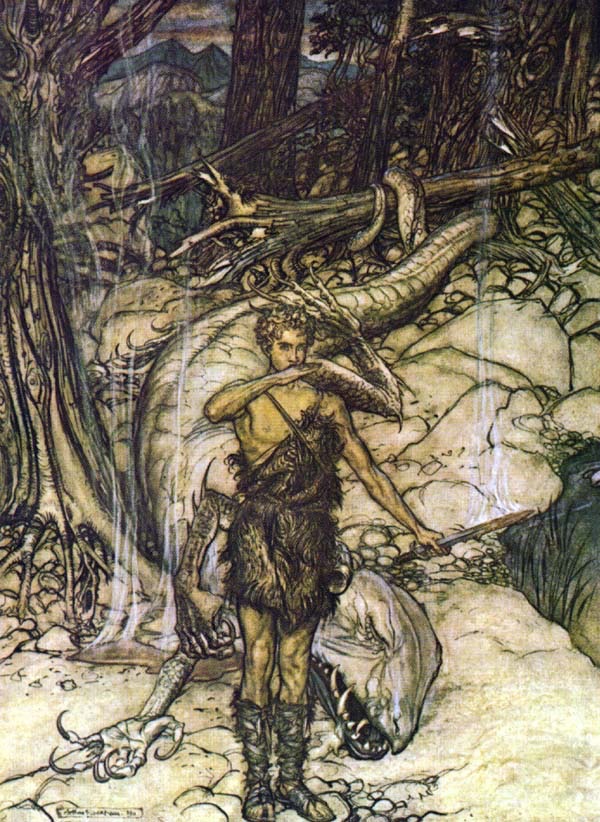
At daybreak, Siegfried and Mime arrive. Mime withdraws while Siegfried confronts the dragon. As Siegfried waits for the dragon to appear, he hears a woodbird. He attempts to mimic the bird’s song using a reed pipe, but is unsuccessful. He then plays a tune on his horn, which brings Fafner out of his cave. After a short exchange, they fight; Siegfried stabs Fafner in the heart with Nothung. In his last moments, Fafner learns Siegfried’s name, and tells him to beware of treachery. When Siegfried withdraws his sword, his hands are burned by the dragon’s blood. On tasting the blood, he finds that he can understand the woodbird’s song. Following its instructions, he takes the Ring and the magic helmet Tarnhelm from Fafner’s hoard.
Scene 3
Outside the cave, Alberich and Mime quarrel over the treasure. Alberich hides as Siegfried comes out of the cave. Siegfried complains to Mime that he has still not learned the meaning of fear. Mime offers him the poisoned drink; however, the dragon’s blood allows Siegfried to read Mime’s treacherous thoughts, and he stabs him to death. He throws Mime’s body into the treasure cave and places Fafner’s body in the cave entrance to block it. The woodbird now sings of a woman sleeping on a rock surrounded by magic fire. Siegfried, wondering if he can learn fear from this woman, follows the bird towards the rock.
Act 3
Scene 1
At the foot of Brünnhilde’s rock. The Wanderer summons Erda, the earth goddess. Erda, appearing confused, is unable to offer any advice. Wotan informs her that he no longer fears the end of the gods; indeed, it is his desire. His heritage will be left to Siegfried the Wälsung, and Brünnhilde (Erda’s and Wotan’s child), who will “work the deed that redeems the World.” Dismissed, Erda sinks back into the earth.
Scene 2
Siegfried arrives, and the Wanderer questions the youth. Siegfried, who does not recognize his grandfather, answers insolently and starts down the path toward Brünnhilde’s rock. The Wanderer blocks his path, but Siegfried mocks him, pointing out his floppy hat and his missing eye, and breaks his spear (the symbol of Wotan’s authority) with a blow from Nothung. Wotan calmly gathers up the pieces and vanishes.Scene 3Brünnhilde’s rock. Siegfried enters the ring of fire, emerging on Brünnhilde’s rock. At first, he thinks the armored figure is a man. However, when he removes the armor, he finds a woman beneath. At the sight of the first woman he has ever seen, Siegfried at last experiences fear. In desperation, he kisses Brünnhilde, waking her from her magic sleep. Hesitant at first, Brünnhilde is won over by Siegfried’s love, and renounces the world of the gods. Together, they hail “light-bringing love, and laughing death.”
Source: Richard Wagner
Following is a text excerpt from the second act
A deep forest
[Quite in the background the entrance to a cave. The ground rises towards a flat knoll in the middle of the stage, and slopes down again towards the back, so that only the upper part of the entrance to the cave is visible to the audience. To the left a fissured cliff is seen through the trees. It is night, the darkness being deepest at the back, where at first the eye can distinguish nothing at all.]
Alberich
[Lying by the cliff, gloomily brooding.]
In night-drear woods
By Neidhöhl’ I keep watch,
With ear alert,
Keen and anxious eye.
Timid day,
Tremblest thou forth?
Pale art thou dawning
Athwart the dark?
[A storm arises in the wood on the right, and from the same quarter there shines down a bluish light.]
What comes yonder, gleaming bright?
Nearer shimmers
A radiant form;
It runs like a horse and it shines;
Breaks through the wood,
Rushing this way.
Is it the dragon’s slayer?
Can it mean Fafner’s death?
[The wind subsides; the light vanishes.]
The glow has gone,
It has faded and died;
All is darkness.
Who comes there, shining in shadow?
Wanderer
[Enters from the wood, and stops opposite Alberich.]
To Neidhöhl’
By night I have come;
In the dark who is hiding there?
[As from a sudden rent in the clouds moonlight streams forth and lights up the Wanderer’s figure.]
Alberich
[Recognises the Wanderer and shrinks back at first in alarm, but immediately after breaks out in violent fury.]
‘Tis thou who comest thus?
What wilt thou here?
Go, get thee hence!
Begone, thou insolent thief!
Wanderer
[Quietly.]
Schwarz-Alberich
Wanders here?
Guardest thou Fafner’s house?
Alberich
Art thou intent
On mischief again?
Linger not here!
Off with thee straightway!
Has grief enough
Not deluged the earth through thy guile?
Spare it further
Sorrow, thou wretch!
Wanderer
I come as watcher,
Not as worker.
The Wanderer’s way who bars?
Alberich
Thou arch, pestilent plotter!
Were I still the blind,
Silly fool that I was,
When I was bound thy captive,
How easy were it
To steal the ring again from me!
Beware! For thy cunning
I know well,
[Mockingly.]
And of thy weakness
I am fully aware too.
Thy debts were cancelled,
Paid with my treasure;
My ring guerdoned
The giants’ toil,
Who raised thy citadel high.
Still on the mighty
Haft of thy spear there
The runes are written plain
Of the compact made with the churls;
And of that
Which by labour they won
Thou dost not dare to despoil them:
Thy spear’s strong shaft
Thou thyself wouldst split;
The staff that makes thee
Master of all
Would crumble to dust in thy hand.
Wanderer
By the steadfast runes of treaties
Thou hast not,
Base one, been bound;
On thee my spear may spend its strength,
So keen I keep it for war.
Alberich
How dire thy threats!
How bold thy defiance!
And yet full of fear is thy heart!
Foredoomed to death
Through my curse is he
Who now guards the treasure.
What heir will succeed him?
Will the hoard all desire
Belong as before to the Niblung?–
That gnaws thee with ceaseless torment.
For once I have got it
Safe in my grasp,
Better than foolish giants
Will I employ its spell.
The God who guards heroes
Truly may tremble!
I will storm
Proud Walhall with Hella’s hosts,
And rule, lord of the world!
Wanderer
[Quietly.]
Thy design I know well,
But little I care:
Who wins the ring
Will rule by its might.
Alberich
Thou speakest darkly,
But to me all is plain.
Thy heart is bold
Because of a boy,
[Mockingly.]
A hero begot of thy blood.
Hast thou not fostered a stripling
To pluck the fruit thou durst not
[With growing violence.]
Pluck frankly for thyself?
Wanderer
[Lightly.]
With me
‘Tis useless to wrangle;
But Mime thou shouldst beware;
For thy brother brings here a boy
To compass the giant’s doom.
He knows not of me;
He works for Mime alone.
And so I say to thee,
Do as seems to thee best.
[Alberich makes a movement expressive of violent curiosity.]
Take my advice,
Be on thy guard:
The boy will hear of the ring
When Mime tells him the tale.
Alberich
[Violently.]
Wilt thou hold thy hand from the hoard?
Wanderer
Whom I love
Must fight for himself unaided;
The lord of his fate,
He stands or falls:
All my hope hangs upon heroes.
Alberich
Does none but Mime
Dispute me the ring?
Wanderer
Only thou and Mime
Covet the gold.
Alberich
And yet it is not to be mine?
Wanderer
[Quietly coming nearer.]
A hero comes
To set the hoard free;
Two Nibelungs yearn for the gold.
Fafner falls,
He who guards the ring;
Then a hand, seizing, shall hold it.
More wouldst thou learn,
There Fafner lies,
Who, if warned of his death,
Gladly would give up the toy.
Come, I will wake him for thee.
[He goes towards the cave, and, standing on the rising ground in front of it, calls towards it.]
Fafner! Fafner!
Wake, dragon! Wake!
Alberich
[With anxious amazement, aside.]
Does the madman mean it?
Am I to have it?
Fafner’s voice
Who troubles my sleep?
Wanderer
[Facing the cave.]
A well-wisher comes
To warn thee of danger;
Thy doom can he averted,
If thou wilt pay the price
With the treasure that thou guardest.
[He leans his ear towards the cave, listening.]
Fafner’s voice
What would he?
Alberich
[Has come to the Wanderer and calls into the cave.]
Waken, Fafner!
Dragon, awake!
A doughty hero comes
To try his strength against thine.
Fafner’s voice
I want a meal.
Wanderer
Bold is the boy and strong;
Sharp-edged is his sword.
Alberich
The ring he seeks,
Nothing besides.
Give me the ring, and so
The strife shall be stayed.
Still guarding the hoard,
In peace shalt thou live long!
Fafner
[Yawning.]
I have and I hold:–
Let me slumber!
Wanderer
[Laughs aloud and then turns again to Alberich.]
Well, Alberich! That ruse failed,
But call me rogue no more.
This one thing thou shouldst
Never forget:
Each according to his kind must act;
Nothing can change him.
I leave thee the field now;
Show a bold front,
And try thy luck with thy brother;
Thou knowest his kind perhaps better.
And things unknown
Thou also shalt learn!
[He turns away, and disappears quickly in the wood. A storm arises and a bright light breaks forth; then both quickly cease.]
Alberich
[Looks after the Wanderer as he gallops off.]
Away on his shining
Horse he rides,
And leaves me to care and scorn!
Laugh on! Laugh on,
Ye light-minded
And high-spirited
Race of immortals!
One day ye shall perish
And pass!
Until the gold
Has ceased to gleam,
Will wise Alberich watch,
And his hate shall prevail.
[He slips into the chasm at the side. The stage remains empty. Dawn.]
As the day dawns Siegfried and Mime enter. Siegfried carries his sword in a sword-belt of rope. Mime examines the place carefully. At last he looks towards the background, which remains in deep shadow, whist the rising ground in the middle becomes, after a time, more and more brightly illuminated by the sun.
Mime
Our journey ends here;
Here we halt.
Siegfried
[Sits down under the lime-tree and looks about him.]
So here I shall learn what fear is?
A far way thou hast led me;
We have wandered lone together
A whole night long in the woods.
This is the last
Of thee, Mime!
Can I not master
My lesson here,
Alone I will push forward
And never see thee again.
Mime
Lad, believe me,
If thou canst not
Learn it here and now,
No other place,
No other time
Ever will teach thee fear.
Dost thou see
That cavern yawning dark?
Yonder dwells
A dragon dread and grim,
Horribly fierce,
Enormous in size,
With terrible jaws
That threaten and gape;
With skin and hair,
All at a gulp,
The brute could swallow thee whole.
Siegfried
[Still sitting under the lime tree.]
‘Twere well to close up his gullet;
His fangs I will therefore avoid.
Mime
Poison pours
From his venomous mouth;
Were he to spue out
Spittle on thee,
Thy body and bones would decay.
Siegfried
That the poison may not consume me,
I will keep out of its reach.
Mime
A serpent’s tail
Sweeping he swings;
Were that about thee wound
And folded close,
Thy limbs would be broken like glass.
Siegfried
That his swinging tail may not touch me,
Warily then I must watch.
But answer me this:
Has the brute a heart?
Mime
A pitiless, cruel heart.
Siegfried
It lies, however,
Where all hearts lie,
Brute and human alike?
Mime
Of course! There, boy,
The dragon’s lies too.
At last thou beginnest to fear?
Siegfried
[Who till now has been lying indolently stretched out, sits up suddenly.]
Nothung into
His heart I will thrust!
Is that what is meant by fearing?
Hey, old dotard!
Canst thou teach me
Nothing but this
With all thy craft,
Linger no longer by me:
No fear is here to be learnt.
Mime
Wait awhile yet!
What I have told thee
Seems to thee empty sound;
When thou hast heard
And seen him thyself,
Thy senses will swoon, overwhelmed?
When thine eyes grow dim,
And when the ground rocks,
When in thy breast
Thy heart beats loud,
[Very friendly.]
Thou wilt remember who brought thee,
And think of me and my love.
Siegfried
Thy love is not wanted!
Hast thou not heard?
Out of my sight with thee;
Let me alone!
Begin again talking of love,
And on the instant I go!
The horrible winking,
The nods and blinking
When shall I see
The last of them,
And rid be at length of the fool?
Mime
Well, I will off,
And rest there by the spring.
Thou must stay here,
And as the sun scales the sky
Watch for the foe:
From his cave
He lumbers this way,
Winds and twists
Past this spot,
To water at the fountain.
Siegfried
[Laughs.]
Liest thou by the spring,
Unchecked thither the brute shall go;
He shall swallow thee
Down with the water,
Ere with my sword
To the heart I stab him!
So heed well what I say:
Rest not beside the spring.
Seek somewhere else
A far-off spot,
And nevermore return.
Mime
Thou wilt not refuse
Cooling refreshment
When the fierce fight is over?
[Siegfried motions him angrily away.]
Call on me too
Shouldst thou need counsel,
[Siegfried repeats the gesture with more violence.]
Or if felled on a sudden by fear.
[Siegfried rises and drives him away with furious gestures.]
Mime
[Aside, as he goes away.]
Fafner and Siegfried–
Siegfried and Fafner–
Might each the other but slay!
[He disappears in the wood on the right.]
Siegfried
[Stretches himself at his ease under the lime-tree, and looks after Mime as he departs.]
He is no father of mine!
How merry of heart I feel!
Never before
Seemed the forest fair;
Never day
Wore as lovely a smile,
For the loathed one has gone at last,
To be looked on by me no more.
[He meditates in silence.]
My father–what was he like?–
Ha! like me, without doubt.
Had Mime by chance had a son,
He would have been
Mime’s image:
Quite as disgusting,
Filthy and grey,
Small and bent,
Hunchbacked and halting,
With ears long and hanging,
Rheumy eyes running–
Off with the fright!
To see him makes me sick!
[He leans further back and looks up through the branches of the tree. Deep silence. Woodland murmurs.]
What could my mother,
I wonder, be like;
That is not
So easy to picture.
[Very tenderly.]
Her clear shining eyes
Must have been soft,
And gentle like the roe-deer’s,
Only far fairer.
[Very softly.]
In fear and woe she bore me,
The hot blood burns like fire!
But why did she die through me?
Must then all human mothers
Thus die on giving
Birth to a son?
That would truly be sad!
Ah, if I only
Could see my mother!–
See my mother,
A woman once!
[He sighs softly, and leans still further back. Deep silence. Louder murmuring of the wood. His attention is at last caught by the song of the birds. He listens with growing interest to one singing in the branches above him.]
O lovely warbler,
I know not thy note;
Hast thou thy home in this wood?
If I could but understand him,
His sweet song might say much–
Perhaps of my mother tell me.
A surly old dwarf
Said to me once
That men might learn
To follow the sense
Of birds when they were singing;
Could it indeed be done?
Ha! I will sing
After him,
On the reed follow him sweetly.
Though wanting the words,
Repeating his measure–
Singing what is his language-
Perhaps I shall know what he says.
[He runs to the neighbouring spring, cuts a reed of with his sword, and quickly makes himself a pipe out of it. He listens again.]
He stops to hear,
So now for my song!
[He blows into the pipe, breaks of, and cuts it again to improve it. He resumes his blowing, shakes his head, and cuts the pipe once more. After another attempt he gets angry, presses the pipe with his hand, and tries again. He ceases playing and smiles.]
That rings not right;
For the lovely tune
The reed is not suited at all.
I fear, sweet bird,
I am too dull;
Thy song cannot I learn.
[He hears the bird again and looks up to him.]
He listens so roguishly
There that he shames me;
[Very tenderly.]
He waits, and nothing rewards him.
Heida! Come hearken
Now to my horn;
[He flings the pipe away.]
All I do sounds wrong
on the stupid reed;
To a song of the woods
That I know,
A merry song, listen now rather.
I hoped it would bring
Some comrade to me,
But wolves and bears
Were the best that came.
Now I will see
Who answers its note:
What comrade will come to its call.
[He takes the silver hunting-horn and blows on it. During the long-sustained notes he keeps his eyes expectantly on the bird. A movement in the background. Fafner, in the form of a monstrous lizard-like dragon, has risen from his lair in the cave. He breaks through the underwood and drags himself up to the higher ground, so that the front part of his body rests on it, while he utters a loud sound, as if yawning.]
Siegfried
[Looks round and gazes at Fafner in astonishment. He laughs.]
My horn with its note
Has allured something lovely;
A jolly companion wert thou.
Fafner
[At the sight of Siegfried has paused on the high ground, and remains there.]
What is that?
Siegfried
If thou art a beast
Who can use its tongue,
Perchance thou couldst teach me something.
Here stands one
Who would learn to fear
Say, wilt thou be his teacher?
Fafner
Is this insolence?
Siegfried
Courage or insolence,
What matter?
With my sword I will slay thee,
Wilt thou not teach me to fear.
Fafner
[Makes a laughing sound.]
Drink I came for;
Now food I find too
[He opens his jaws and shows his teeth.]
Siegfried
What a fine set of teeth
Thou showest me there!
Sweetly they smile
In thy dainty mouth!
‘Twere well if I closed up thy gullet
Thy jaws are gaping too wide!
Fafner
They were not made
For idle talk,
But they will serve
To swallow thee.
Siegfried
Hoho! Ferocious,
Merciless churl!
I have no fancy
To be eaten.
Better it seems to me
That without delay thou shouldst die!
Fafner
[Roaring.]
Pruh! Come,
Boy, with thy boasts!
Siegfried
[Draws his sword.]
*
Source: sacred texts

 Sila Blume
Leave a comment