Götterdämmerung (Twilight of the Gods) is the last in the music drama set of four, entitled Der Ring des Nibelungen (The Ring of the Nibelung) or The Ring Cycle or The Ring for short) which premiered at the Bayreuth Festspielhaus on 17 August 1876, concluding the first performance of the complete cycle.
The title is the German translation from the Old Norse phrase Ragnarök, referring in Norse mythology to a prophecy of a war among various beings and gods that ultimately results in the burning, immersion in water, and renewal of the world.
Background and context
Wagner had long been interested in early Norse and German heroic poetry, including the medieval German epic Nibelungenlied (“Song of the Nibelung”), when he sketched out a prose version of the Nibelung myth in 1848. His first libretto to use that version was called Siegfrieds Tod (“The Death of Siegfried”), which became the basis of Götterdämmerung. He began composing the music in 1850, but he soon realized that he could not tell of Siegfried’s death without first telling of his life. In 1851 he wrote the libretto for Der junge Siegfried (“The Young Siegfried”; later shortened to Siegfried). Continuing back toward the beginning of the story, he finished the librettos for Die Walküre and Das Rheingold, respectively, in 1852. After completing the massive text, he composed the operas in the order of the story. The first two were composed by 1856, and then Wagner took a long break to complete Tristan und Isolde and Die Meistersinger von Nürnberg before completing Siegfried in 1871 and Götterdämmerung in 1874—26 years after he started work on the project.
Der Ring des Nibelungen, or the Ring cycle, is an unsurpassed exaltation of German heritage and mythology. In places, Wagner tells the story with the orchestra, using leitmotifs—fragments of melody that convey emotions and themes as they recur in varying contexts. It is even possible for the orchestra to convey ideas that are hidden from the characters themselves—an idea that later found its way into film scores.
Wagner was perpetually in need of funds, and the Ring would be extremely expensive to stage. Faced with a double motivation, Wagner conducted a series of concerts that featured orchestral excerpts from his forthcoming epic. Most famous of those is the Ride of the Valkyries, which opens the last act of Die Walküre, second of the four operas; other frequently encountered excerpts are the Entry of the Gods into Valhalla from Das Rheingold; Magic Fire Music from Die Walküre; Forest Murmurs from Siegfried; and Siegfried’s Rhine Journey, Siegfried’s Funeral March, and Brünnhilde’s Immolation Scene from Götterdämmerung. The concerts provided him with a steady income, and they whetted the public appetite for the operas that would follow.
The original and ongoing home of the cycle, the Festspielhaus in Bayreuth, was built to the composer’s specifications at the command of Bavaria’s King Louis II (often referred to by his German name, Ludwig). The first festival, which consisted of three multiday performances of the cycle, drew some of the best-known musical figures of the age, including Franz Liszt, Pyotr Ilyich Tchaikovsky, Camille Saint-Saëns, and Anton Bruckner. The festival lost money, and the staging of the operas was problematic because of the complexity of the set design. The music was another story. Whatever others thought of Wagner’s vocal writing and ponderousness, none could deny his control of harmony, dramatic structure, and orchestration. Wagner had reimagined opera.
Main cast of Der Ring des Nibelungen
Brünnhilde, a Valkyrie (soprano)
Sieglinde, Wotan’s human daughter (soprano)
Freia, goddess of youth (soprano)
Gutrune of the Gibichungs (soprano)
Fricka, Wotan’s wife (mezzo-soprano)
Waltraute, a Valkyrie (mezzo-soprano)
Erda, goddess of the earth (contralto)
Siegmund, Wotan’s human son (tenor)
Froh, god of the sun (tenor)
Loge, god of fire (tenor)
Mime, a Nibelung (tenor)
Wotan, king of the gods (bass-baritone)
Alberich, a Nibelung (bass-baritone)
Donner, god of thunder (bass-baritone)
Hunding, Sieglinde’s husband (bass)
Gunther of the Gibichungs (bass)
Hagen, son of Alberich and half brother to the Gibichungs (bass)
Fafner, a giant (bass)
Fasolt, a giant (bass)
3 Rhinemaidens, 3 Norns (the Fates), 7 more Valkyries, and the Forest Bird.
Written by Betsy Schwarm
Source: Britannica
PROLOGUE
At night on the Valkyries’ rock, the three Norns, daughters of Erda, weave the rope of destiny. They tell how Wotan ordered the world ash tree, from which his spear was once cut, to be felled and its wood piled around Valhalla. The burning of the pyre will mark the end of the old order. Suddenly the rope breaks. Their wisdom ended, the Norns descend into the earth.
Dawn breaks and Siegfried and Brünnhilde emerge. Having cast protective spells on him, she sends him into the world to do heroic deeds. As a pledge of his love, Siegfried gives her the ring he took from the dragon Fafner, and she offers her horse, Grane, in return. Siegfried sets off on his travels.
ACT I
In the hall of the Gibichungs on the banks of the Rhine, Gunther and Gutrune discuss the royal family’s diminishing glory with their half-brother, Hagen. Hagen advises them to strengthen their rule through marriage, suggesting Brünnhilde as Gunther’s bride and Siegfried as Gutrune’s husband. Since only the strongest hero can pass throught the fire on Brünnhilde’s rock, Hagen proposes a daring plan: a potion will make Siegfried forget Brünnhilde and fall in love with Gutrune. To win her as his wife, he will claim Brünnhilde for Gunther. When Siegfried’s horn is heard from the river, Hagen calls him ashore. Gutrune offers the potion to Siegfried, who salutes Brünnhilde as he takes the cup but immediately confesses his love for Gutrune after he has drunk. When Gunther describes his chosen bride, Siegfried offers to walk through the flames for him, using the Tarnhelm to transform himself into Gunther. The two men take an oath of blood brotherhood and set out on their quest. Hagen remains behind to guard the hall.
The Valkyrie Waltraute, horrified by the impending destruction of Valhalla, arrives at Brünnhilde’s rock to ask for her sister’s help: The only way to save the gods, she says, is for Brünnhilde to give the ring back to the Rhinemaidens, its rightful owners. Brünnhilde refuses, declaring that Siegfried’s love is more important to her than the fate of the gods. Waltraute leaves in despair. When Siegfried’s horn is heard in the distance, Brünnhilde is overjoyed at his return. Her happiness quickly turns into confusion and terror when a strange figure appears before her, claiming her as Gunther’s bride and tearing the ring from her hand.
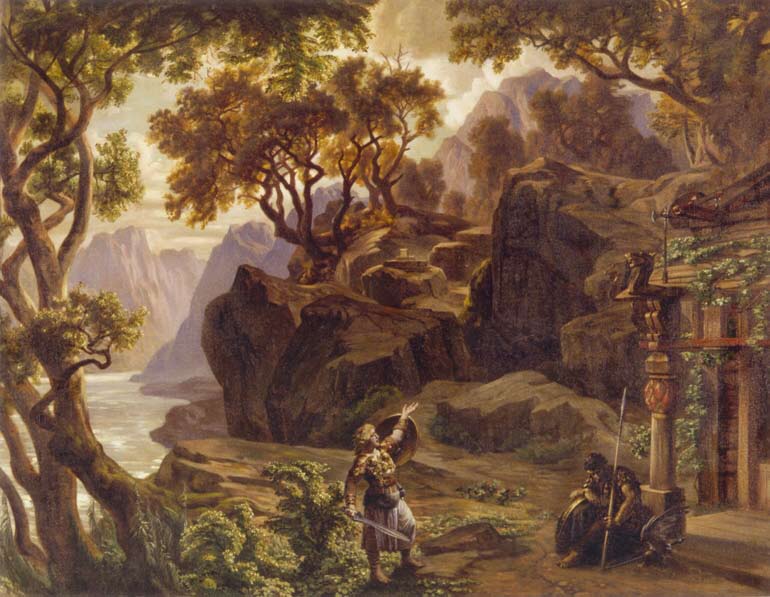
– Act II, Scene 2
ACT II
As Hagen sits sleeping outside the Gibichungs’ hall at night, Alberich appears as if in a dream and reminds his son that he has to win back the ring. Dawn breaks and Siegfried arrives. Hagen summons the Gibichungs to welcome Gunther, who enters with the humiliated Brünnhilde. When she sees Siegfried, she furiously accuses him of betraying her. Still under the spell of the potion, Siegfried tells her he is to marry Gutrune and that she will become Gunther’s wife. Noticing the ring on Siegfried’s finger, Brünnhilde demands to know who gave it to him, since the night before it was taken from her, supposedly by Gunther. Accusing Siegfried of having stolen the ring, Brünnhilde declares he is her husband. Siegfried protests, swearing on Hagen’s spear that he has done no wrong. He dismisses Brünnhilde’s accusations and leads Gutrune and the men away to celebrate.
Brünnhilde can only think of vengeance. Hagen offers to kill Siegfried, but she explains that he is invincible: she has protected him with magic—except for his back, which he would never turn to an enemy. Gunther hesitates to join the conspiracy of murder but finally gives in.
ACT III
Siegfried, separated from his hunting party, meets the three Rhinemaidens by the banks of the river. They ask him to return the ring to them and he almost agrees, but when they tell him of Alberich’s curse he decides to keep it as proof of his fearlessness. The Rhinemaidens predict his imminent death and disappear as Hagen, Gunther, and the other hunters arrive. Encouraged by Hagen, Siegfried tells of his youth and his life with Mime, the forging of the sword Nothung, and his fight with the dragon. While he is talking, Hagen offers him wine containing an antidote to the potion. His memory restored, Siegfried describes how he walked through the fire and woke Brünnhilde. At the mention of her name, Hagen stabs Siegfried with his spear and tells the shocked Gunther that he avenged a false oath. Siegfried remembers Brünnhilde with his last words and dies.
Gutrune wakes from a bad dream, wondering what has happened to Siegfried. When his body is brought in, she accuses Gunther of murder, who replies that Hagen committed the deed. The two men fight about the ring and Gunther is killed. As Hagen reaches for the ring, the dead Siegfried threateningly raises his arm, terrifying everyone. Brünnhilde enters and calmly orders a funeral pyre to be built on the banks of the Rhine. She denounces the gods for their guilt in Siegfried’s death, takes the ring from his hand and promises it to the Rhinemaidens. Then she lights the pyre and leaps into the flames. The river overflows its banks and destroys the hall. Hagen, trying to get to the ring, is dragged into the water by the Rhinemaidens, who joyfully reclaim their gold. In the distance, Valhalla and the gods are seen engulfed in flames.
Source: Metropolitan Opera

 Sila Blume
Leave a comment