William Tell, German Wilhelm Tell, is the Swiss legendary hero who symbolized the struggle for political and individual freedom.
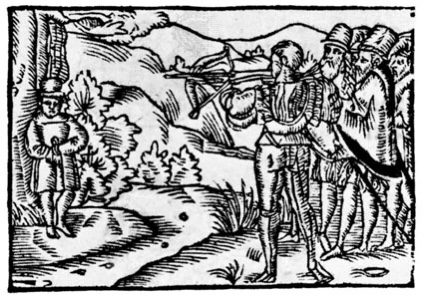
The historical existence of Tell is disputed. According to popular legend, he was a peasant from Bürglen in the canton of Uri in the 13th and early 14th centuries who defied Austrian authority, was forced to shoot an apple from his son’s head, was arrested for threatening the governor’s life, saved the same governor’s life en route to prison, escaped, and ultimately killed the governor in an ambush. These events supposedly helped spur the people to rise up against Austrian rule.
The classic form of the legend appears in the Chronicon Helveticum (1734–36), by Gilg Tschudi, which gives November 1307 as the date of Tell’s deeds and New Year 1308 as the date of Switzerland’s liberation. There is no evidence, however, for the existence of Tell; but the story of the marksman’s test is widely distributed in folklore. In the early Romantic era of nationalist revolutions, the Tell legend attained worldwide renown through the stirring play Wilhelm Tell (1804) by the German dramatist Friedrich von Schiller.
ACT I Switzerland, 1307. Guillaume Tell leads the Swiss resistance against the Austrian overlords, led by Gessler. Tell is championed by Melcthal, patriarch of the village, and (hesitantly) by Melcthal's son Arnold, who is in love with the Austrian princess Mathilde. An archery contest, in which Tell's son Jemmy is victorious, is interrupted by the arrival of Leuthold, who has killed an Austrian soldier who was trying to rape his daughter. Tell ferries him over the rapids and when the Austrians arrive, the Swiss refuse to reveal the identity of the ferryman. The Austrians, led by Rodolphe, take Melcthal as a hostage and then loot the village.
ACT II Arnold and Mathilde proclaim their love but they are interrupted by Tell's arrival. He urges Mathilde to leave and then tells Arnold that his father has been executed. Arnold agrees to support a revolt, and there is a meeting of the three cantons to discuss the uprising.
ACT III Arnold and Mathilde, recognizing the futility of their relationship, agree to part. In the main square Gessler is demanding obedience, and he orders the Swiss to bow before his hat. When Tell refuses, Rodolphe recognizes him as the ferryman and has him arrested. Gessler challenges Tell to shoot an apple off the head of Jemmy, his son. He succeeds, then is arrested again and sent by Gessler to the castle of Kussnacht, situated between Lake Lucerne and Lake Zug. The Swiss people's outraged reaction to this is barely checked by the Austrian soldiers. Mathilde takes Jemmy into her care.
ACT IV On the lake's edge Arnold urges his compatriots to rise against the Austrians, then leads them into battle. Jemmy is reunited with his mother Hedwig by Mathilde and then lights a pyre, signalling the beginning of the uprising. Tell returns to the mainland and kills Gessler, while Arnold captures the castle of Altdorf. The opera ends with a prayer of thanksgiving.
 Sila Blume
Leave a comment